

Competition in the 21st century is evolving beyond traditional battlefields and now spans outer space, cyberspace, financial markets, research laboratories, universities, and the invisible networks that connect modern societies. Understanding this evolving ecosystem requires not only detailed research but also clear visual frameworks that help analysts, policymakers, acquisition professionals, corporate strategy teams, hedge funds and defense technology investors quickly grasp complex strategic dynamics. Using deep domain expertise and expert cartography skills, we hand draw each ecosystem into a clear, understandable framework we call a Vignette.
The Great Power Competition Visual Research Series, produced by PWK International Advisors, presents a set of analytical vignettes designed to illustrate the major operational domains shaping strategic competition between the United States, the People’s Republic of China and Russia in what one senior defense intelligence official called “The Science War of the Century”. Each vignette synthesizes open-source research into a single integrated visual model highlighting the technologies, institutions, and tactics that define modern rivalry between major powers.
Who These Are For
- Policy analysts and think tanks
- Military professionals and planners
- Defense acquisition professionals
- Hedge funds and investment researchers
- Academic researchers and university instructors
- Journalists covering defense and geopolitics
- Corporate strategy and risk professionals
Each vignette can be used as a stand-alone research reference or as part of a complete analytical series illustrating how competition unfolds across multiple domains—from influence operations and economic penetration to autonomous warfare and space-based surveillance.
High-resolution versions of the graphics are available for purchase for use in presentations, research publications, academic instruction, and professional briefings.
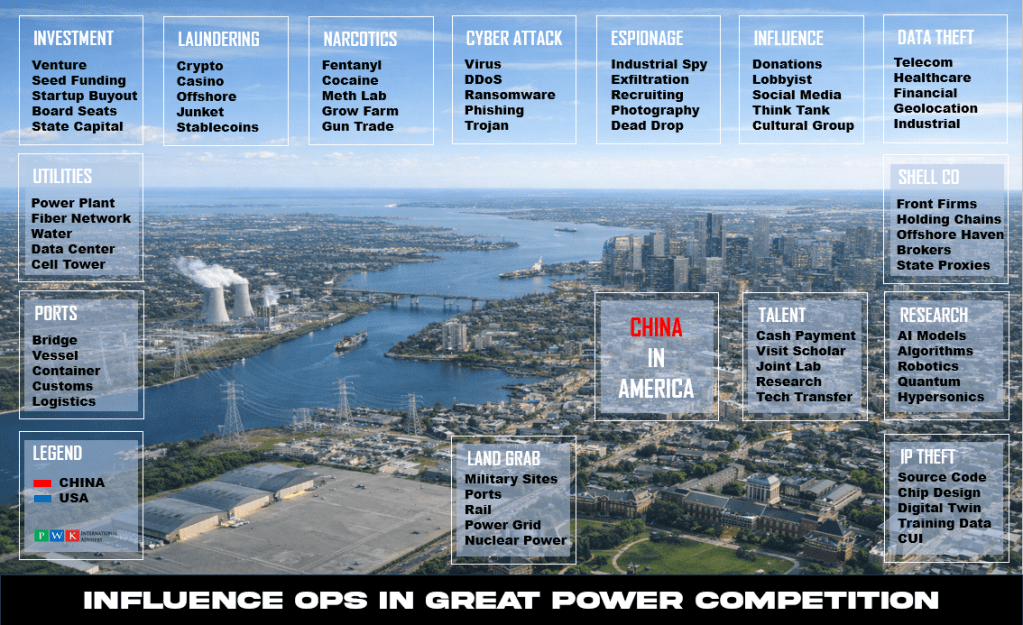
This vignette illustrates the broad ecosystem of influence operations that shape strategic competition between the United States and China. Unlike traditional espionage, influence campaigns operate across political, financial, technological, and cultural channels.
Influence Ops in Great Power Competition highlights mechanisms such as venture investment, academic collaboration and hidden cash payments, money laundering and crypto schemas, shell corporate structures, persistent cyber operations, and strategic land acquisitions near sensitive infrastructure and military bases. These activities can allow foreign actors to gain access to technology, information, and economic leverage while operating within otherwise legitimate institutional frameworks.
By mapping these vectors within a single urban environment—including universities, financial districts, ports, energy infrastructure, and transportation networks—the chart demonstrates how influence activities intersect with critical infrastructure and systems that support modern societies.
The purpose of this visual framework is to help analysts recognize how economic activity, foreign intelligence collection, and technological acquisition often intersect in subtle but strategically significant ways.
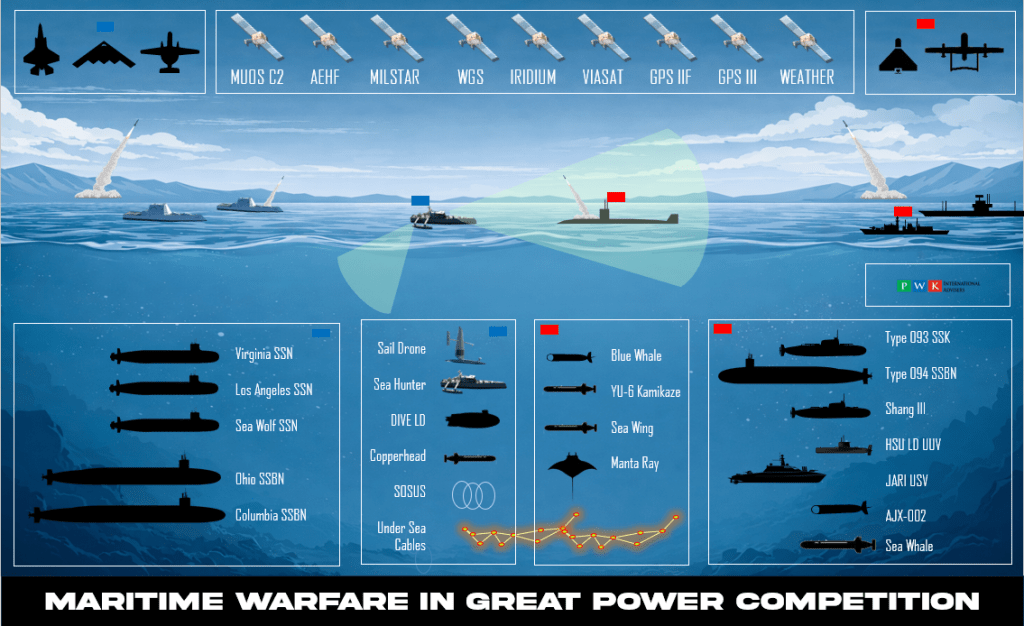
Control of the world’s oceans has long been a cornerstone of geopolitical power. In the 21st century, maritime competition between major powers is evolving beyond traditional naval fleets to include autonomous systems, long-range precision weapons, undersea networks, and distributed surveillance architectures. The Maritime Warfare in Great Power Competition vignette illustrates the expanding ecosystem of technologies and operational concepts shaping naval strategy between the United States and China.
The chart highlights the layered structure of modern maritime operations, including surface combatants, submarines, unmanned surface vessels, and underwater drones operating across contested sea lanes and strategic chokepoints. These platforms are supported by a network of satellite surveillance, maritime patrol aircraft, seabed sensors, and long-range targeting systems that enable forces to monitor and respond to activity across vast ocean areas.
The vignette also emphasizes the growing importance of autonomous maritime systems, such as robotic surface vessels and underwater drones capable of conducting surveillance, mine countermeasures, and long-endurance patrol missions. These systems allow naval forces to extend their reach while reducing risk to human crews.
Equally important are the command-and-control networks that integrate maritime forces into broader joint operations across air, cyber, and space domains. Data fusion, satellite communications, and real-time sensor networks allow naval commanders to coordinate distributed fleets and respond rapidly to emerging threats.
By mapping these capabilities within a single operational framework, the Maritime Warfare vignette provides a visual overview of how modern naval competition now combines traditional fleets, autonomous systems, advanced sensors, and networked targeting architectures. The result is a maritime battlespace that is increasingly interconnected, technologically sophisticated, and central to the strategic balance between major powers.
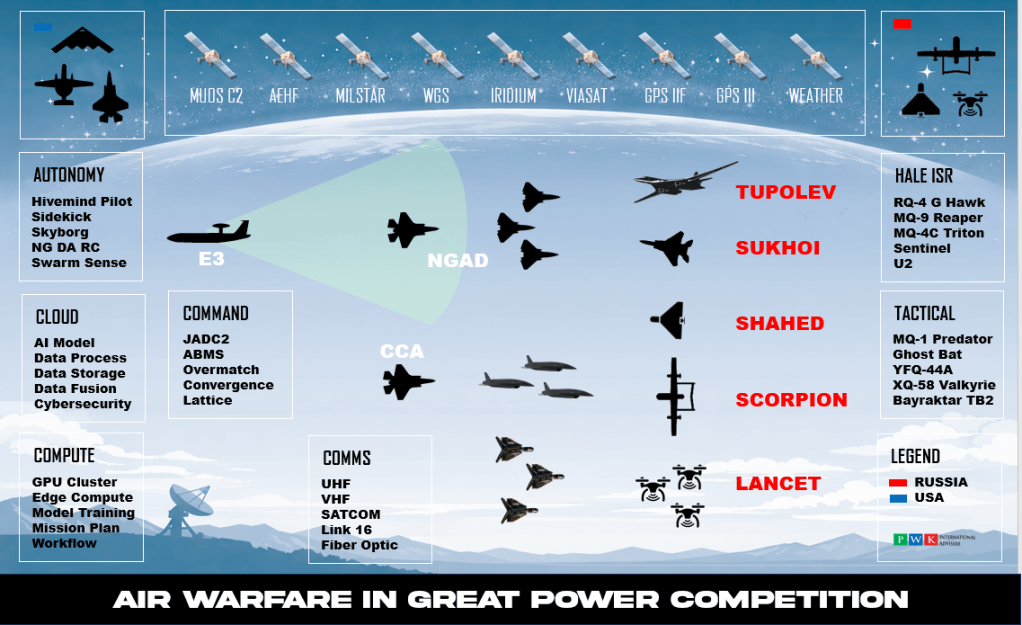
Airpower remains one of the most decisive components of modern military competition. The Air Warfare in Great Power Competition vignette illustrates the expanding ecosystem of aircraft, autonomous systems, surveillance platforms, and precision weapons that define contemporary air operations.
The graphic integrates several categories of capability, including Loyal Wingman (CCA), Next Generation Air Dominance (NGAD), high-altitude intelligence platforms, stealth reconnaissance aircraft, tactical strike drones, loitering munitions, and emerging autonomous combat aircraft. These systems operate alongside command-and-control networks, satellite communications, and sensor fusion architectures that allow air forces to maintain awareness across vast geographic areas.
The chart also highlights the increasing importance of attritable systems and drone swarms, which are reshaping the economics of air combat by allowing forces to deploy large numbers of relatively inexpensive platforms to overwhelm defenses or conduct distributed surveillance. This vignette provides a visual overview of how modern air warfare integrates ISR, autonomy, networking, and precision strike capabilities into a unified operational framework.
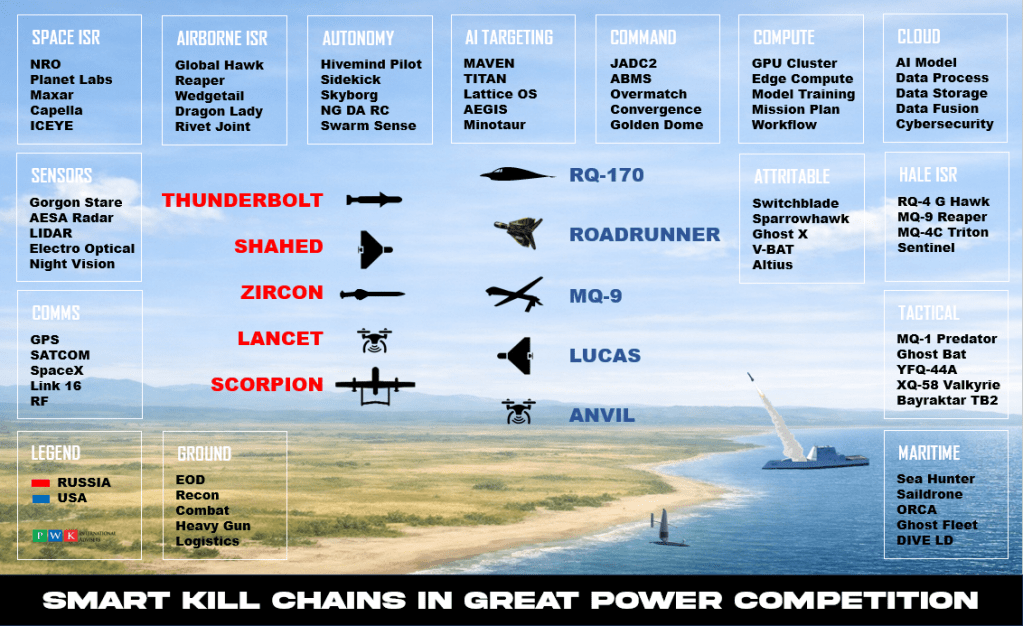
Modern warfare increasingly depends on the ability to rapidly detect, identify, track, and strike targets across multiple domains, day or night, in all weather. The DoD has embraced AI powered targeting through efforts liked JADC2, Project Overmatch and Project Maven. The Smart Kill Chains in Great Power Competitions vignette illustrates how artificial intelligence, autonomous systems, and networked sensors are transforming the traditional military targeting process.
The vignette highlights the integration of satellite reconnaissance, airborne ISR platforms, autonomous drones, advanced sensors, cloud computing infrastructure, and joint command-and-control architectures. Systems such as AI-assisted targeting platforms, swarm autonomy, and distributed data fusion enable militaries to process massive volumes of information and convert them into actionable targeting decisions at unprecedented speed.
The vignette also depicts the growing role of attritable systems, tactical drones, and maritime autonomous platforms, which expand the operational reach of military forces while reducing risk to human operators. Together, these capabilities represent a shift from linear targeting chains to dynamic, AI-enabled networks capable of operating simultaneously in real time across land, sea, air, cyber, and space.
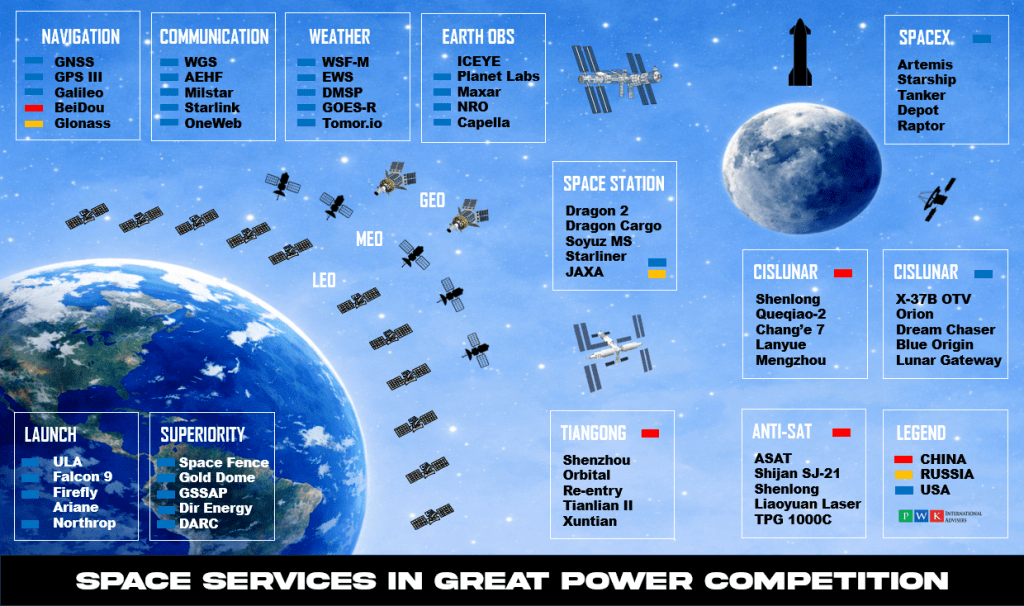
Space services and cislunar space has become a critical domain of contested strategic competition between major powers. Satellites provide the backbone for navigation, communications, intelligence collection, missile warning, and global command networks.
Space Services in Great Power Competition illustrates the constellation of technologies that support both commercial, research and military operations on orbit and the emerging capabilities designed to contest that domain. These include reconnaissance satellites, synthetic aperture radar systems, communications relays, navigation constellations, and missile tracking sensors.
The Vignette also highlights the growing importance of launch infrastructure, space domain awareness systems, and defensive capabilities designed to protect satellite networks from interference or attack.
Because nearly every modern military operation depends on space-based systems, control of the orbital environment has become a critical element of national power. This vignette provides a visual overview of the infrastructure and technologies shaping space service modernization, cislunar exploration and the innovations powering the commercial and military space race.
Purchasing the Visual Research Series
High-resolution versions of these vignettes are available for purchase for professional and educational use. These visuals are designed to support research, analysis, and education on the evolving dynamics of great power competition in the 21st century.
Pricing
Individual Vignette — $100
Complete Five-Vignette Series — $400
How it Works
Purchases include a high-resolution PNG suitable for presentations, research publications, and classroom instruction. Make your selections below and provide your email address and information. We will invoice you at the email address you provide. Upon payment, you will receive your order via email, usually within 1 business day.
To purchase a vignette or the complete series, please use the order form or contact us directly for institutional licensing and bulk orders.



 pwkinternational.com