

The Arctic is no longer a silent, frozen expanse relegated to scientific missions and indigenous habitation. It has transformed into a nexus of strategic competition, driven by melting ice caps, abundant resources, and geopolitical maneuvering. The region, often referred to as the “last frontier,” is poised to play a pivotal role in global security, resource exploitation, and trade routes. The United States, Russia, and China are now engaged in a race to shape the Arctic’s future, each bringing unique strengths and strategies to the table.
In this article, we will explore five key concepts shaping the Arctic’s emerging role in global geopolitics. We will examine the region’s vast natural resources and their potential to shift the global energy landscape, and we will analyze the military buildup in the Arctic, focusing on the strategies of the United States, Russia, China and Scandinavia. We will delve into the evolving trade routes, including the Northern Sea Route, and their implications for global commerce, and we will discuss the environmental and indigenous challenges posed by Arctic development. Finally, we will consider the international frameworks and alliances attempting to govern this strategically critical region amidst rising tensions.
Strategic Competition in the Arctic: Unlocking Hidden Wealth
The Arctic is home to an estimated 20% of the world’s undiscovered oil and 30% of its untapped natural gas, according to the U.S. Geological Survey. These reserves, valued in trillions of dollars, have sparked renewed interest in the region. In the United States, the Arctic National Wildlife Refuge (ANWR) remains a focal point for oil and gas exploration. While legislation in 2017 authorized drilling, environmental concerns and shifting political priorities have slowed development.

Russia, on the other hand, has aggressively pursued Arctic resource extraction. Its state-run corporations, including Gazprom and Rosneft, dominate hydrocarbon production in the region. Moscow’s focus on the Arctic extends beyond energy; it includes rare earth minerals and fisheries, both of which hold strategic economic importance.
China, although not an Arctic state, has identified the region as a critical part of its Belt and Road Initiative (BRI). Through its “Polar Silk Road” strategy, Beijing has invested in Arctic infrastructure projects, including ports and research stations, aiming to secure access to resources and shipping lanes.

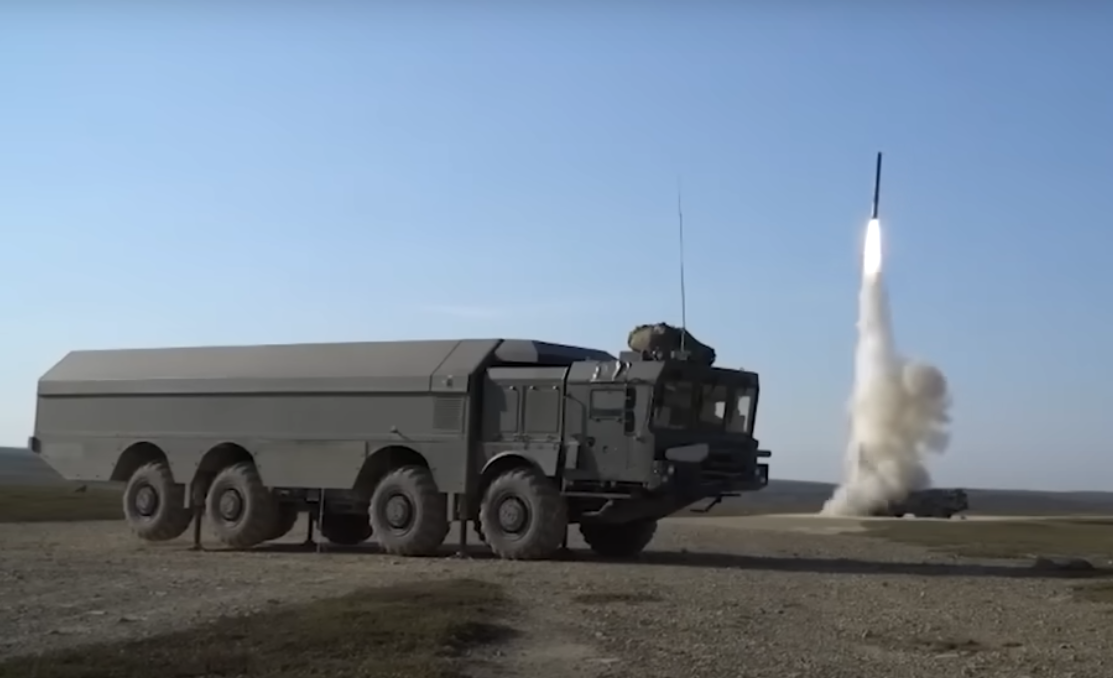

Russia’s Arctic Dominance and China’s Ambitions
Climate change has dramatically altered the Arctic’s geography, opening new navigational routes like the Northern Sea Route (NSR) and the Northwest Passage. These routes promise to cut shipping times between Asia and Europe by up to 40%, significantly reducing costs and fuel consumption. Russia, which controls much of the NSR, has heavily militarized the route, requiring foreign ships to seek permission and often pay fees. This control grants Moscow strategic leverage over global trade, a factor that has not gone unnoticed by Western powers.
The United States and Canada, while possessing significant Arctic coastlines, face challenges in asserting control over their respective waters. Disputes over the legal status of the Northwest Passage—whether it constitutes international waters or Canadian internal waters—highlight the complexities of Arctic governance.
Russia has fortified its Arctic presence with a network of military bases, radar stations, and airfields. The country’s fleet of over 50 icebreakers, including nuclear-powered vessels, dwarfs that of any other nation. These assets allow Russia to maintain year-round access to Arctic waters, a capability unmatched globally.
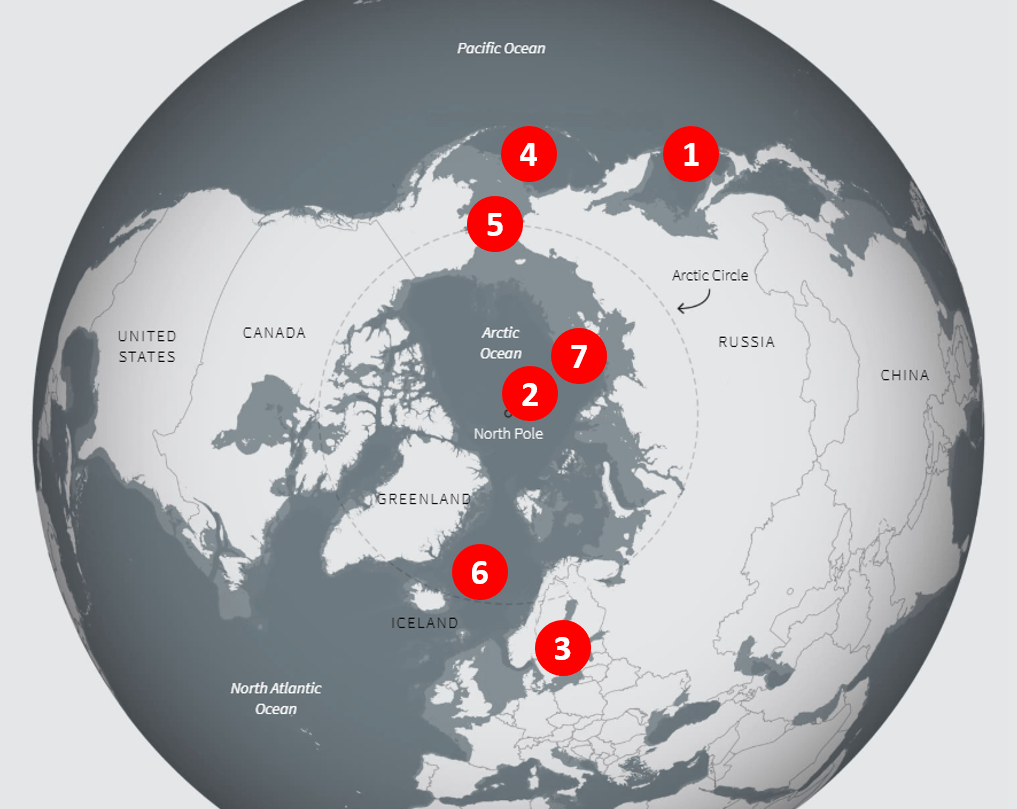
Russian and Chinese Military Exercises in the Polar Region
| 1. Vostok (East): A large-scale Russian military drill focusing on Arctic and eastern defense strategies, involving air, naval, and ground forces in extreme climates. |
| 2.Umka Expedition: A Russian Arctic exercise showcasing under-ice submarine operations and military endurance in harsh polar conditions. |
| 3. Ocean Shield (Russia): Russia’s naval exercise in the Arctic and adjacent seas, emphasizing maritime dominance and power projection in polar waters. |
| 4. Northern Fleet Maneuvers: Russia’s Arctic-focused naval and ground forces training, often incorporating amphibious operations on icy coastlines. |
| 5. Xue Long (“Snow Dragon”) Deployment: A Chinese Arctic naval expedition testing the capabilities of its icebreaker fleet in polar navigation and operations. |
| 6. Polar Silk Road Naval Drills: China’s Arctic drills aimed at improving logistics and military cooperation along its Belt and Road Arctic strategy. |
| 7. China’s Arctic Research Icebreaker Exercises: Dual-purpose Chinese missions combining scientific research with military training to develop capabilities in polar waters. |
Moreover, Russia’s Arctic strategy is closely tied to its nuclear deterrence posture. The Kola Peninsula houses a significant portion of Russia’s submarine-launched ballistic missiles (SLBMs), underscoring the region’s importance to national security. Recent upgrades to its Bastion defense system further enhance Moscow’s ability to deny access to adversaries.
China’s approach to Arctic militarization is subtler but no less strategic. Through dual-use facilities, such as research stations that can also collect intelligence, Beijing has gradually increased its influence. While it lacks an Arctic coastline, China’s investments in the region aim to ensure it remains a stakeholder in Arctic governance.
The U.S. Response
The United States faces significant challenges in the Arctic. Its icebreaker fleet, consisting of only two operational vessels, is grossly inadequate compared to Russia’s. The Polar Security Cutter (PSC) program seeks to address this shortfall by building a modern fleet of heavy and medium icebreakers. However, delays and funding constraints have pushed the delivery of the first PSC to 2030 .

The Department of Defense has also increased Arctic military exercises and established partnerships with NATO allies to enhance readiness. The recent deployment of advanced aircraft and the construction of upgraded radar systems signal a shift in U.S. strategy toward Arctic deterrence.
Security, Sovereignty, and Icebreaking Capabilities
The United States, while less active in Arctic militarization, recognizes the strategic necessity of maintaining a strong presence. U.S. Coast Guard initiatives, such as the Polar Security Cutter (PSC) program, aim to rebuild America’s aging icebreaker fleet. The PSC represents a critical step toward addressing gaps in Arctic operations, including search and rescue missions, scientific research, and maritime security. However, with only two operational icebreakers—compared to Russia’s 50—the U.S. lags significantly.

Polar Security Cutters (PSCs): Program Overview
The Polar Security Cutter (PSC) program, launched with the Coast Guard’s FY2013 budget submission, aims to acquire four to five new heavy polar icebreakers, followed later by medium polar icebreakers. Previously known as the Polar Icebreaker Program, the name change highlights the vessels’ broader national security missions beyond icebreaking. On February 24, 2022, the Coast Guard announced the first PSC would be named Polar Sentinel, with additional names already under consideration for subsequent ships.
The PSCs will be homeported in Seattle, Washington, where the Coast Guard’s current polar icebreakers are stationed. The program is managed by a Coast Guard-Navy Integrated Program Office (IPO), established to leverage the Navy’s expertise in ship procurement to streamline the design and acquisition process. While the Coast Guard initially targeted 2024 for the delivery of the lead ship, delays have pushed the expected delivery date to 2030.
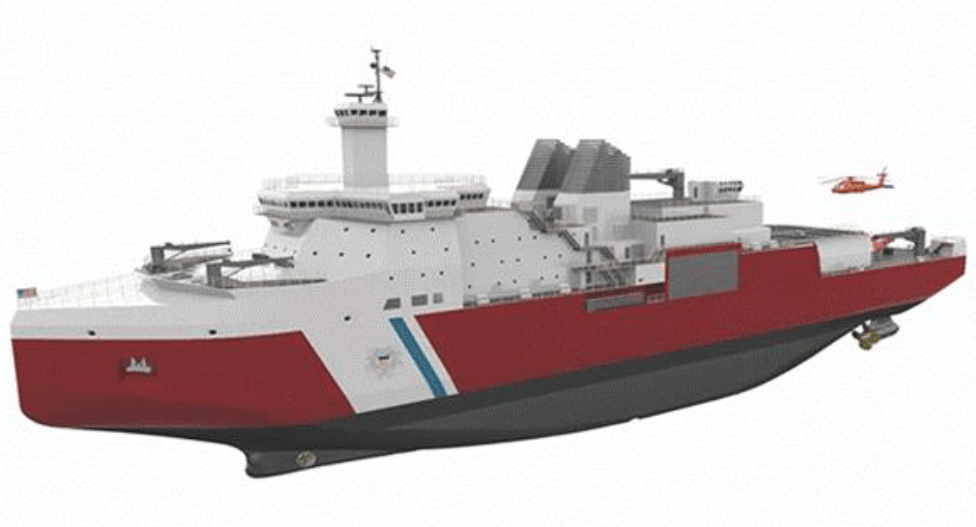
Multiple Missions Beyond Icebreaking
The U.S. Coast Guard’s polar icebreakers serve as versatile, multi-mission vessels, carrying out a wide range of operations beyond icebreaking that are typically performed by general-purpose cutters in lower-latitude waters. These icebreakers play a crucial role in supporting nine of the Coast Guard’s eleven statutory missions, including:
- Conducting and facilitating scientific research in both the Arctic and Antarctic.
- Upholding U.S. sovereignty in Arctic territorial waters through consistent presence.
- Protecting U.S. economic interests within the exclusive economic zone (EEZ) north of Alaska.
- Monitoring sea traffic, including vessels heading to the United States, in Arctic waters.
- Performing essential Coast Guard functions such as search and rescue, law enforcement, and marine resource protection in Arctic territories.
Polar Operations Spanning Both Hemispheres
The Coast Guard’s large icebreakers are referred to as polar icebreakers because their missions extend beyond the Arctic to include the Antarctic. A substantial portion of these operations is dedicated to supporting the National Science Foundation (NSF) in its research efforts across both polar regions.
Required Numbers of Coast Guard Polar Icebreakers
In 2023, the Coast Guard reported that its updated fleet mix analysis identified the need for a total of eight to nine polar icebreakers to meet its Arctic and Antarctic mission requirements. This fleet would include four to five heavy polar icebreakers and four to five medium polar icebreakers. Previously, the Coast Guard had stated a minimum requirement of six polar icebreakers, with at least three designated as heavy polar icebreakers.
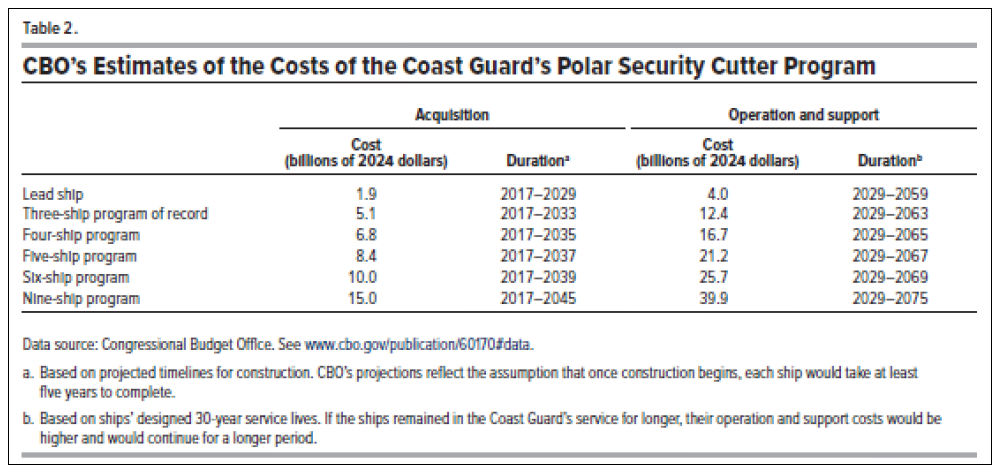
At a Senate Armed Services Committee hearing on March 14, 2024, Air Force General Gregory M. Guillot, Commander of U.S. Northern Command (USNORTHCOM), emphasized the critical shortfall in U.S. icebreaking capabilities, noting, “We’re severely outnumbered… even with the additional icebreakers being procured, we will still face significant limitations on our freedom of maneuver in the region.”
Canada’s Response
With Maritime activity in the region making a dramatic upswing and the potential for disputes leading to conflict, security and military preparations have gone into high-gear. Perhaps the greatest risk of conflict arises from a Canada declaration that the waters of the Arctic archipelago are within their territorial sovereignty and that transiting ships are subject to Canadian laws, a position rejected by the US and other nations who have declared the NWP is an international strait. For Canada to uphold her position, she will have to demonstrate she holds control of the vital sea route.
In fact, Canada has initiated a large-scale mobilization of resources to monitor and protect the sovereignty of her North. This includes space, air, sea and land assets drawn from the Department of National Defense and Canadian Coast Guard (CCG) as well as coordinated activities with government transportation agencies.
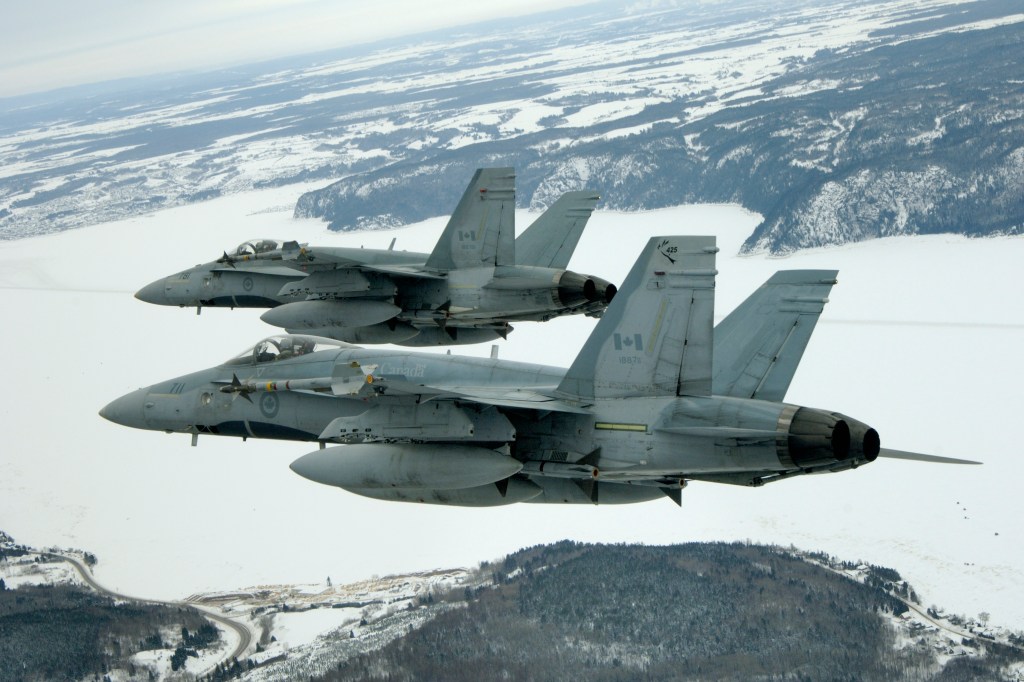
Increased surveillance and control missions have also initiated new acquisition programs including Polar Class offshore patrol ships and unmanned air vehicle surveillance systems. New force structure initiatives have also been implemented including the establishment at Resolute Bay of the Canadian Forces Arctic Training Center, an increase in Canadian Ranger forces, and a new ship fueling operation at Nanisivik. At the same time, Canada Command has beefed up operations among six regional commands including Joint Task Force North (JTFN) whose mission is to enforce control across all three northern territories.
Canadian Coast Guard vessels include two 14,500 ton Gulf class heavy ice breakers and four medium ice breakers. These 1980’s era vessels comprise an incredibly miniature fleet with respect to the sea area they are expected to maintain.
Climate Change: Friend and Foe
The paradox of the Arctic lies in its vulnerability to climate change and the opportunities it creates. Melting ice has exposed new resources and navigational routes, but it has also heightened environmental risks. Fragile ecosystems face threats from oil spills, overfishing, and industrial activity.
Climate change also complicates military operations. The harsh environment demands specialized equipment and training, both of which require substantial investment. Additionally, as the ice recedes, traditional Arctic defense strategies based on natural barriers must be reimagined.
Tough Tech in the Arctic: Re-imagining Sub Zero Conflict

The Arctic is one of the most challenging environments on Earth, demanding unparalleled toughness and innovation from the technologies that operate there. As global strategic competition intensifies in the region, the need for advanced systems capable of withstanding freezing temperatures, limited visibility, and rugged terrain has grown exponentially. From unmanned aerial vehicles to specialized naval and land-based platforms, a new wave of Arctic-focused defense technologies is redefining how nations operate in the polar regions. These systems are not only critical for maintaining security and sovereignty but also for facilitating vital missions such as search and rescue, environmental monitoring, and scientific research.
This section highlights the top companies at the forefront of Arctic technology innovation. These firms, ranging from unmanned systems pioneers to cutting-edge manufacturers of thermal imaging and naval solutions, have developed products uniquely designed to endure the extreme conditions of the Arctic. Their contributions showcase the intersection of technological ingenuity and operational necessity, offering a glimpse into the future of defense and exploration in one of the world’s most inhospitable yet strategically significant frontiers.
| Patria Oyj (Helsinki, Finland): Manufactures Arctic-operable armored vehicles like the Patria AMV XP for extreme climates. |
| Huntington Ingalls Industries (HII). (Newport News, Virginia, USA) Constructs advanced ice-capable ships, including the Polar Security Cutter, for navigation and military missions in Arctic waters. |
| General Atomics Aeronautical Systems (Poway, California): Produces the MQ-9B SkyGuardian, a UAV adapted for Arctic reconnaissance and maritime patrol. |
| Rheinmetall AG (Düsseldorf, Germany): Manufactures Arctic-ready vehicles like the Boxer MRAV and advanced air defense systems. |
| Kongsberg Defence & Aerospace (Kongsberg, Norway): Provides the Naval Strike Missile (NSM) and Protector RWS, both optimized for Arctic operations. |
| SAAB AB (Stockholm, Sweden): Offers Giraffe AMB radar and Arctic-modified naval combat systems for extreme environments. |
| Anduril Industries (Costa Mesa, California): Develops Arctic-capable autonomous systems like Lattice, Ghost and Sentry Tower for surveillance and defense. |
| FLIR Systems (Teledyne) (Wilsonville, Oregon): Creates thermal imaging devices such as the Tactical Reconnaissance Kit for cold-weather military operations. |
| Thales Group (Paris, France): Designs communication and sensor systems optimized for polar military operations. |
All registered trade marks and trade names are the property of the respective owners.
Arctic Governance
Enforcement Challenges in a
Multi-polar World
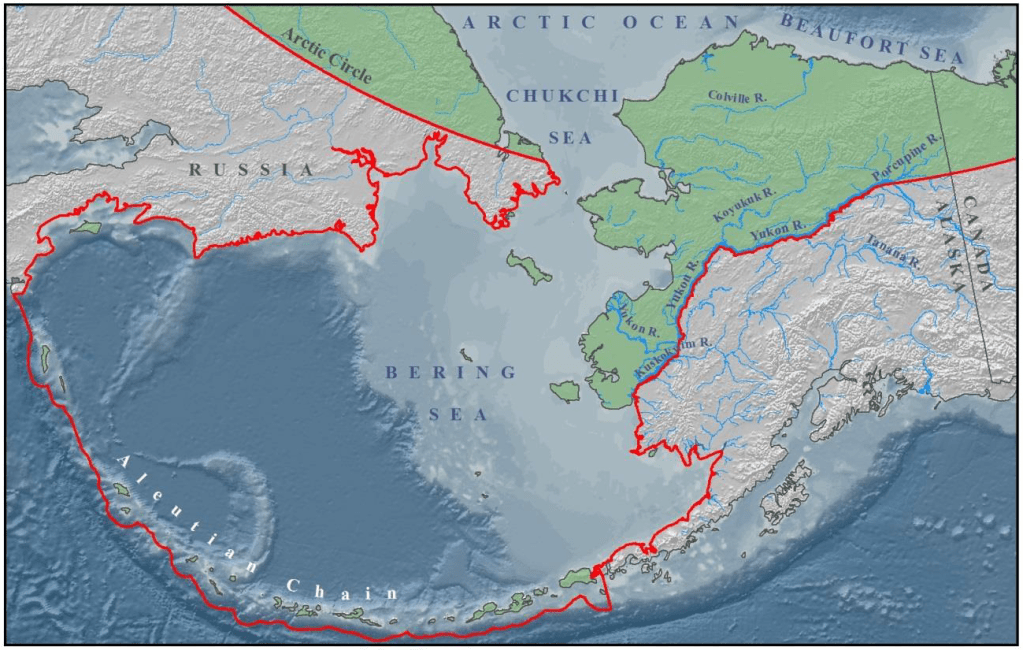
The Arctic Council, comprising eight member states, remains the primary forum for Arctic cooperation. However, it lacks the authority to resolve disputes or enforce decisions, limiting its effectiveness.
International law, particularly the United Nations Convention on the Law of the Sea (UNCLOS), provides a framework for Arctic governance but is often subject to differing interpretations. For example, Russia’s expansive claims to the Arctic seabed, based on its continental shelf, have drawn criticism from the United States and other nations.
As the overall tempo of military activity continues to escalate in the region, so to does the likelihood of a “non-diplomatic” confrontation between the stakeholders. Reconciling the competing territorial claims, maritime right of way, environmental group concerns, irredentist claims and sovereignty preservation actions of the state actors involved will be an extremely complex challenge. Just as nature applies its laws to the harsh beauty of this wild frontier, the need for an internationally acceptable solution grows at an inverse proportion to the remarkable speed with which the ice field shrinks.
Key Takeaways and Strategic Observations
1. Economic Stakes are High
The Arctic’s resource wealth and shipping routes offer unparalleled economic opportunities. Control over Arctic resources offers both economic leverage and energy security, driving competition among states. For the United States, balancing resource exploitation with environmental conservation is critical.
2. Russia’s Military Advantage is Clear
With its superior icebreaking fleet and military infrastructure, Russia dominates the Arctic theater. Russia’s military dominance and China’s creeping influence demand a recalibration of U.S. Arctic strategy. Enhancing military infrastructure and partnerships with NATO allies is vital. Countering this advantage requires a significant U.S. investment in Arctic capabilities.
3. China is Playing the Long Game
China’s economic and scientific activities in the Arctic are part of a broader strategy to influence regional governance. Its investments should be scrutinized for dual-use potential.
4. Infrastructure Gaps are a Weakness
The United States must address its limited Arctic infrastructure, from icebreakers to deep-water ports, to ensure operational readiness. The U.S. must also expedite the modernization of its icebreaking fleet to project power and fulfill its commitments in polar regions.
5. Multilateral Cooperation is Essential
Addressing Arctic challenges requires robust international collaboration. Strengthening alliances with NATO and Arctic Council member states can counterbalance adversarial activities. At the same time the Arctic Council and other international frameworks must evolve to address overlapping claims and mitigate conflict potential.


Conclusion
The Arctic is no longer a remote, frozen frontier—it is a dynamic, contested space with significant implications for global security and commerce. The Arctic represents a frontier where climate change, resource competition, and great power rivalry converge. For the United States, ensuring strategic readiness in the Arctic is no longer optional—it is essential. By investing in infrastructure, enhancing its icebreaking capabilities, and engaging in multilateral diplomacy, the U.S. can secure its interests while promoting stability in this frozen, yet fiercely contested region.
For the United States, securing its interests in the Arctic demands a comprehensive strategy that balances military preparedness, economic development, and environmental stewardship. As the ice melts, the great power competition will only heat up.
Sources, Acknowledgements and Image Credits
{1} Polar Opposition: Americas Big Problem in the Arctic. CAPTION: Three polar bears approach the starboard bow of the Los Angeles-class fast attack submarine USS Honolulu (SSN 718) while surfaced 280 miles from the North Pole. Sighted by a lookout from the bridge (sail) of the submarine, the bears investigated the boat for almost 2 hours before leaving. Commanded by Cmdr. Charles Harris, USS Honolulu while conducting otherwise classified operations in the Arctic, collected scientific data and water samples for U.S. and Canadian Universities as part of an agreement with the Arctic Submarine Laboratory (ASL) and the National Science Foundation (NSF). Photo Credit: Wikimedia Commons
{2} Where the riches are hidden. Greenland is hydrocarbon rich according to various geological estimates. Map Credit: PWK International Advisers
{3} Strategic Competition in the Arctic: Unlocking Hidden Wealth. Photo Credit: Russian Federation
{4} Russian and Chinese Military Exercises in the Polar Region. Map Credit: PWK International Advisers
{5} CAPTION: Elmendorf Air Force Base, Alaska — Tech. Sgt. Jeffery Austin monitors radar to track and identify air traffic in Alaska and Canada during Alaska Shield/Northern Edge. The exercise assembles an integrated federal, state and local capability of prevention, preparedness, response and recovery for extreme events including terrorism. Sergeant Austin is an air surveillance technician with the 176th Control Squadron here. (U.S. Air Force photo by Airman 1st Class Anthony Nelson Jr.)
{6} Risk Assessment: Polar Missions with Performance Gaps. Data Source: Congressional Research Service (CRS). Coast Guard Polar Security Cutter (Polar Icebreaker) Program: Background and Issues for Congress. November 19, 2024
{7} CAPTION: An artist’s rendering of VT Halter Marine U.S. Coast Guard Polar Security Cutter. Image Credit: Bollinger Shipyards | VT Halter Marine. All registered trade marks and trade names are the property of the respective owners
{8} Source: The Congressional Budget Office (CBO) estimate of the the US Coast Guard Polar Security Cutter (PSC) program. Table Credit: Congressional Budget Office
{9} CAPTION: Two aircraft from Canadas 425 Tactical Fighter Squadron 3 Wing Bagot Ville, fly over Arrondissement Chicoutimi of ville de Saguenay. The 2 CF-18 Hornets are armed with 2 radar-guided AIM-7 Sparrow missiles and 2 heat-seeking AIM-9 Sidewinder missiles. Photo taken by Private Pierre Theriault, Imaging Section, 3 Air Maintenance Squadron, 3 Wing Bagot Ville, from a CF-18B piloted by Major Daniel Dionne, deputy commandant, 425 Squadron.
{10} Tough Tech in the Arctic: Re-imagining Sub Zero Conflict. Image Credit: Undisclosed
{11} Arctic Governance: Enforcement Challenges in a Multi-polar World. Map of arctic boundary as defined by the Arctic Research and Policy Act (ARPA). National Science Foundation via. Arctic Research Mapping Application (amap.org) and the Interagency Arctic Research Policy Committee (ARPC). Map Author: Allison Gaylord, Nuna Technologies
{12} Tough Tech in the Arctic: Re-imagining Sub Zero Conflict. Our unbiased analysis includes mention of specific tough tech manufacturers and their arctic conflict innovations. All registered trade marks and trade names are the property of the respective owners
About PWK International Advisers
PWK International provides national security consulting and advisory services to clients including Hedge Funds, Financial Analysts, Investment Bankers, Entrepreneurs, Law Firms, Non-profits, Private Corporations, Technology Startups, Foreign Governments, Embassies & Defense Attaché’s, Humanitarian Aid organizations and more.
Services include telephone consultations, analytics & requirements, technology architectures, acquisition strategies, best practice blue prints and roadmaps, expert witness support, and more.
From cognitive partnerships, cyber security, data visualization and mission systems engineering, we bring insights from our direct experience with the U.S. Government and recommend bold plans that take calculated risks to deliver winning strategies in the national security and intelligence sector. PWK International – Your Mission, Assured.



















 pwkinternational.com