

As global conflicts increasingly hinge on data, nations that can control and process information at scale are poised to hold significant power. The ability to gather, analyze, and distribute data rapidly and accurately has emerged as a critical strategic advantage, particularly in military and geopolitical contexts. In a world where decision-making is powered by vast datasets, the race to dominate data is intensifying.
In the digital age, data is more than just a resource—it is a force multiplier, a cornerstone of global power rivalries. Nations and corporations alike are racing to harness the capabilities of advanced data centers to gain strategic advantage, a phenomenon often referred to as “data supremacy.” These centers, powered by cutting-edge CPUs and GPUs, serve as the backbone for everything from artificial intelligence and big data analytics to national defense and financial markets. Yet, as demands for computational power soar, so too do the challenges of scalability, security, and sustainability, forcing a paradigm shift in how data infrastructure is conceived and operated.
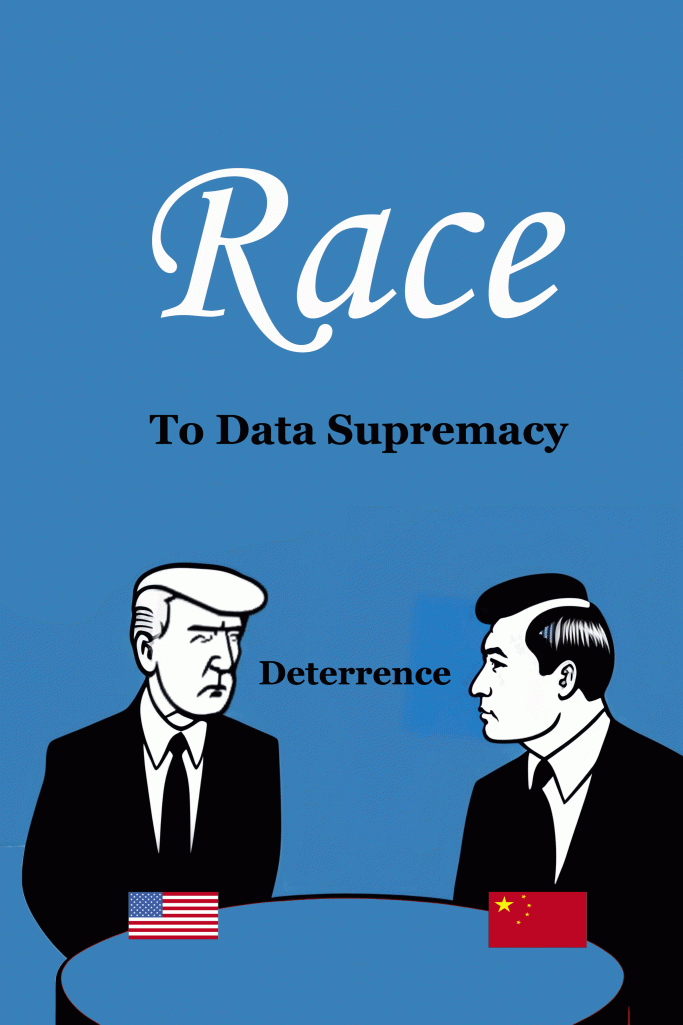
The implications extend far beyond technology. Data centers are emerging as geopolitical instruments, reshaping alliances and rivalries. As countries like China and Russia invest heavily in their data and energy infrastructures, the West faces a critical choice: innovate or risk falling behind. Nuclear-powered data hubs stand at the nexus of this challenge, offering not just technological superiority but also strategic independence in an increasingly connected and competitive world. This report will explore how these advancements can transform global power dynamics while addressing ethical, technical, and security challenges.
The Evolution of Data Centers
The journey of data centers from humble beginnings to hyperscale powerhouses mirrors the exponential growth of the digital world. In their earliest form, server rooms were localized, housing bulky hardware for basic data processing. Over the decades, these rooms transformed into sprawling, climate-controlled facilities capable of handling petabytes of information, underpinned by CPUs that formed the foundation of modern computation. However, the advent of cloud computing, big data, and artificial intelligence drove demand far beyond what traditional architectures could sustain. The integration of GPUs into data centers became a pivotal development, enabling parallel processing at scales required for tasks like AI model training, real-time analytics, and high-frequency stock trading.
A Brief History of Data Centers
Despite these advancements, current data centers face significant limitations, particularly in energy consumption and environmental impact. Powering a hyperscale facility often requires as much electricity as a small city, with cooling systems alone accounting for a substantial share of energy use. Additionally, many centers remain tethered to fossil fuel grids, undermining global sustainability efforts. The inefficiencies in scaling and the rising costs of operation have created a bottleneck, limiting the ability of nations and enterprises to expand their data capabilities at the pace required to remain competitive in the race for data supremacy.
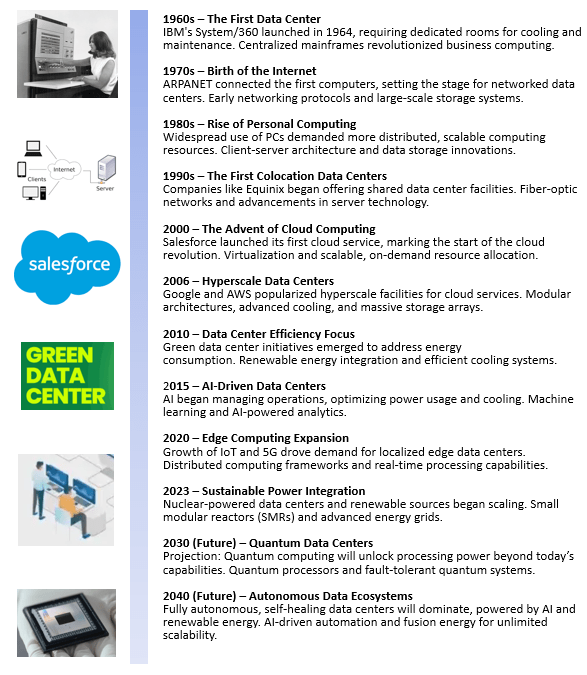
The next evolution in data center design seeks to address these limitations by integrating disruptive technologies like nuclear energy and modular GPU-based infrastructures. Nuclear power, especially through small modular reactors (SMRs), offers a cleaner, more reliable energy source to fuel the data demands of the future. Meanwhile, GPU-driven architectures provide the computational agility to handle complex operations efficiently, from training advanced AI to powering real-time decision-making systems. Together, these innovations mark a turning point, transforming data centers into self-sustaining hubs capable of not only supporting technological progress but also becoming strategic assets in the geopolitical theater.
What is Data Fabric?
Data fabric is a modern approach to unify and streamline data across an organization, connecting disparate systems, platforms, and sources into a single, accessible layer. It acts as a bridge between data silos—pulling information from legacy systems, data lakes, warehouses, and applications—to deliver a cohesive and consistent view of data at scale.
Key features of data fabric include abstraction techniques that simplify access to underlying sources, integration tools to harmonize data formats, and robust governance to ensure quality, security, and compliance. Additionally, observability mechanisms help track and optimize data workflows and pipelines, enhancing operational efficiency.
Data fabric enables organizations to make data interoperable, trustworthy, and easily discoverable. By moving toward a more federated environment, it allows users to access and exchange data dynamically, while ensuring granular control and context through advanced attribute-level tagging. This transformative framework is reshaping how organizations unlock value from their data.

Case Study | Data Fabric in Defense & Intelligence
The Defense Simulation Analytical Service (DSaS), powered by AI & Red Hat OpenShift, is a defense data fabric for CIA and Air Force Intelligence officers. It is a scalable platform ecosystem that can leverage data, visualizations, and simulation capabilities to deliver informed decision support. DSaS presents information to analysts in various integrated views using artificial intelligence (AI) and machine learning (ML) to provide prioritized insights with confidence scores and explainability of assertions back to their sources.
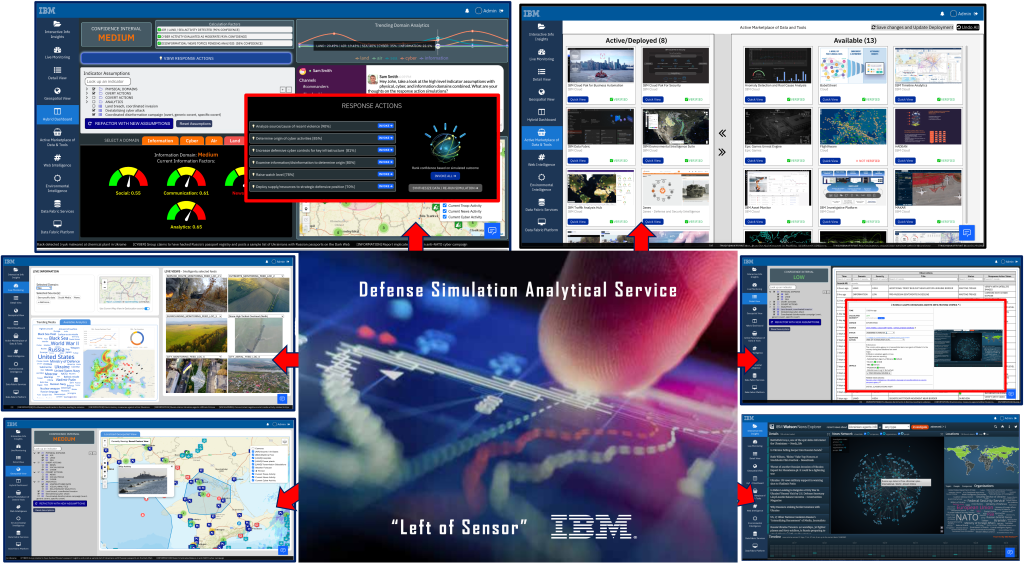
DSaS also provides the ability to visualize information campaigns similar to how military campaigns are viewed in the air, sea, cyber, and land domains, to better understand how to posture against competing campaigns simultaneously in all domains. DSaS gives decision makers flexibility to practice decision making against a thinking enemy under conditions of uncertainty. It can help determine the best course of action at the speed of relevance in a competition with a determined and actively thinking and reacting opponent in a world filled with volatility, uncertainty, complexity, and ambiguity (VUCA).
The Data Infrastructure Revolution: Energy and Computing Power
One of the major barriers to achieving data supremacy is the power required to support vast data infrastructures. Traditional data centers, while effective, consume massive amounts of energy and rely heavily on fossil fuels. As the demand for data processing grows exponentially, so does the need for energy-efficient and sustainable power solutions.
As the world’s data needs surge, the integration of nuclear power into data center infrastructure is emerging as a revolutionary solution to the twin challenges of energy sustainability and computational efficiency. Small modular reactors (SMRs), a new wave of nuclear technology, provide scalable and reliable energy that can meet the enormous demands of hyperscale data centers. Unlike traditional reactors, SMRs are compact, safer, and more versatile, making them suitable for powering remote facilities and critical infrastructure. By offering an uninterrupted, low-carbon energy source, nuclear-powered data centers can alleviate the environmental toll of traditional power grids while ensuring operational resilience against energy disruptions.

In parallel, GPUs are redefining the computational landscape within data centers. Unlike CPUs, which process tasks sequentially, GPUs excel at parallel processing, enabling faster and more efficient handling of data-intensive workloads. These capabilities are critical in areas such as artificial intelligence, where training large models or running inference at scale requires immense processing power. By deploying GPU-optimized architectures alongside nuclear energy, data centers can handle increasingly complex tasks—such as real-time decision-making for defense systems or predictive analytics for global supply chains—at speeds and scales previously unimaginable.
The fusion of these two innovations signals a new paradigm for data center design, one that balances sustainability with performance. Nuclear-powered GPU hubs can operate independently of traditional energy grids, providing strategic advantages for governments and enterprises aiming to secure critical data operations. Moreover, the combination of cutting-edge computation and clean energy supports broader goals of digital sovereignty and climate neutrality. This infrastructural synergy is not just a technical leap forward—it is a geopolitical statement, signaling readiness to lead in the race for data supremacy while addressing the pressing demands of a connected, data-driven world.
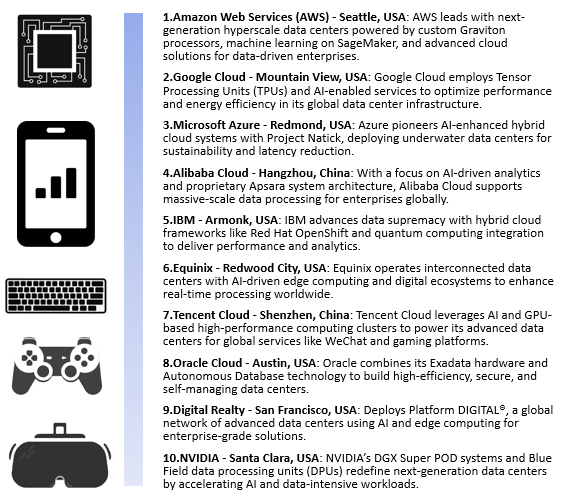
Todays Cloud Services Providers: Innovations and Sustainability
AI and Autonomous Systems: Driving the Data Arms Race
The integration of artificial intelligence into data processing systems is accelerating the shift towards data-driven decision-making. AI, particularly machine learning and deep learning, allows for the processing of vast amounts of data to identify patterns, predict outcomes, and make decisions autonomously. This capability is transforming industries ranging from defense and cybersecurity to finance and healthcare. For example, in military operations, AI-driven systems can predict enemy movements, assess battlefield conditions, and even engage in automated combat tactics with minimal human intervention.

Machine learning and deep learning unlocks data to identify patterns, predict outcomes and make automated decisions
To remain competitive, nations must develop not only the infrastructure to store and process massive data sets but also the AI systems capable of analyzing this data and generating actionable insights. This requires the development of sophisticated algorithms, data frameworks, and, importantly, the computational power to run them. GPUs are essential in this equation, as they allow for the parallel processing necessary to train AI models and run complex simulations in real-time. The combination of AI and advanced data centers will thus form the backbone of next-generation warfare, where data will dictate strategy, and decisions will be made by machines in milliseconds.
Geopolitics of Data Supremacy

Data has become a currency of power, redefining the dynamics of international relations. Nations that control the flow, analysis, and application of data are poised to gain a decisive edge in both economic and military spheres. The concept of “data supremacy” highlights this shift, with advanced data centers at the heart of this new global contest. The ability to collect, process, and deploy information at the speed of relevance is not just advantageous but necessary for maintaining geopolitical dominance. Countries like China and Russia are investing heavily in their data infrastructures, leveraging AI and edge computing to extend their influence across domains, from cyber warfare to international commerce.
Beyond military implications, data supremacy also influences economic and diplomatic power. Nations that host the most efficient, secure, and advanced data centers can attract global enterprises, setting the stage for technological and financial hegemony. Nuclear-powered, GPU-optimized data centers are poised to become the gold standard, offering unmatched reliability and performance while aligning with global sustainability goals. As the world moves closer to a data-centric paradigm, the ability to dominate this domain will define the balance of power in the 21st century, forcing nations and organizations to rethink their strategies for maintaining relevance and security in a complex and multi-polar world.
Global Data Powerhouses: The World’s Most Influential Data Centers

| 1. The Citadel Campus (Switch) – Nevada, USA: The world’s largest data center, powered by 100% renewable energy, uses Switch’s patented Tier 5® Platinum infrastructure for unmatched security and scalability. |
| 2. Lakeside Technology Center – Chicago, USA: A colocation hub hosting hyperscale clients, equipped with advanced cooling systems and high-density power for efficient data processing. |
| 3. Equinix DC11 – Ashburn, USA: Located in “Data Center Alley,” it features advanced interconnection services and Equinix Cloud Exchange Fabric™ for seamless multi-cloud connectivity. |
| 4. Google Data Center – Hamina, Finland: Known for its innovative seawater cooling system, it utilizes AI-powered energy management and sustainable infrastructure. |
| 5. Next Generation Data (NGD) – Newport, Wales: Europe’s largest data center, powered by renewable energy and designed with high-security Tier III specifications for enterprise-grade operations. |
| 6. Alibaba Cloud Data Center – Hangzhou, China: Features proprietary Apsara architecture and GPU-driven computation to support e-commerce, AI, and big data analytics. |
| 7. Microsoft Azure Quincy Data Center – Washington, USA: Integrates AI-driven operational management and waterless cooling to optimize performance and reduce environmental impact. |
| 8. Digital Realty Data Hub – Singapore: Serves as a critical interconnection point in Asia, using intelligent energy management systems and offering high-speed connectivity across the region. |
| 9. Facebook Clonee Data Center – Dublin, Ireland: Powered entirely by renewable energy, it employs AI to maximize cooling efficiency and minimize energy use. |
| 10. China Telecom Inner Mongolia Information Park – Hohhot, China: One of the world’s largest cloud service hubs, featuring advanced fiber-optic networks and energy-efficient cooling systems tailored for AI and big data applications. |
| 11. Vantage Data Centers Campus – Frankfurt, Germany: A key European data hub with state-of-the-art cooling systems and modular designs, supporting high-density colocation and cloud services for global enterprises. |
| 12. Interxion Science Park – Amsterdam, Netherlands: Known for its strategic location and advanced interconnection services, it hosts a wide range of cloud providers and enterprises with low-latency connections across Europe. |
| 13. Green Mountain Data Center – Stavanger, Norway: A sustainable Tier III-certified facility built inside a former NATO bunker, powered by hydroelectric energy and utilizing fjord water for natural cooling. |
| 14. DataPro Moscow Data Center – Moscow, Russia: One of the largest and most advanced facilities in Russia, it offers Tier III-certified infrastructure with high-capacity power, energy-efficient cooling, and robust security systems tailored for enterprise and government clients. |
| 15. Khazna Data Centers (Core 42) – Abu Dhabi, UAE: The largest data center in the Middle East, offering Tier III-certified colocation services with advanced energy-efficient cooling and high-density power capabilities to support hyperscale cloud and enterprise operations. |
| 16. NEXTDC S2 Data Center – Sydney, Australia: A cutting-edge Tier IV-certified facility, it features advanced energy-efficient cooling, solar power integration, and high-speed interconnection services, supporting enterprise and cloud providers across the Asia-Pacific region. |
| 17. Ascenty Campinas Data Center – São Paulo, Brazil: One of South America’s largest data centers, it features Tier III certification, advanced connectivity through a proprietary fiber-optic network, and high-energy efficiency to support cloud and enterprise clients across the region. |
| 18. Teraco Johannesburg Data Center (JB1) – Johannesburg, South Africa: Africa’s largest interconnection hub, offering Tier III-certified facilities with advanced cooling technologies and high-speed connectivity to support cloud services and enterprises across the continent. |
The Need for Interoperability and Collaboration
The U.S. military has already initiated efforts such as the Joint All Domain Command and Control (JADC2) strategy, which aims to link all military branches and allied forces through a single data fabric, enabling real-time, cross-domain decision-making. However, challenges persist, particularly regarding data security, privacy, and governance. Ensuring that data is shared securely across borders and between entities will require advanced encryption methods, secure data exchange protocols, and rigorous standards for data governance. These technical advancements, alongside the establishment of common operational standards, are key to ensuring that data systems work together, and deliver improved mission outcomes for war fighters.

Cybersecurity and Data Privacy
Cyberattacks, particularly those targeting data centers, have become a significant concern for national security. To protect against cyber threats, the integration of advanced security technologies such as quantum safe cryptography, blockchain for data provenance, multi-factor authentication, and continuous monitoring systems will be essential. Data must not only be protected while in transit but also during storage and processing. Furthermore, data centers need to be designed with redundancies that allow them to continue functioning even under attack or in the event of infrastructure failure. Creating a secure, resilient infrastructure that can withstand both cyber and physical attacks is key to maintaining the integrity of national security systems and economic operations.
(more on cybersecurity).
Building the Infrastructure for Data Supremacy
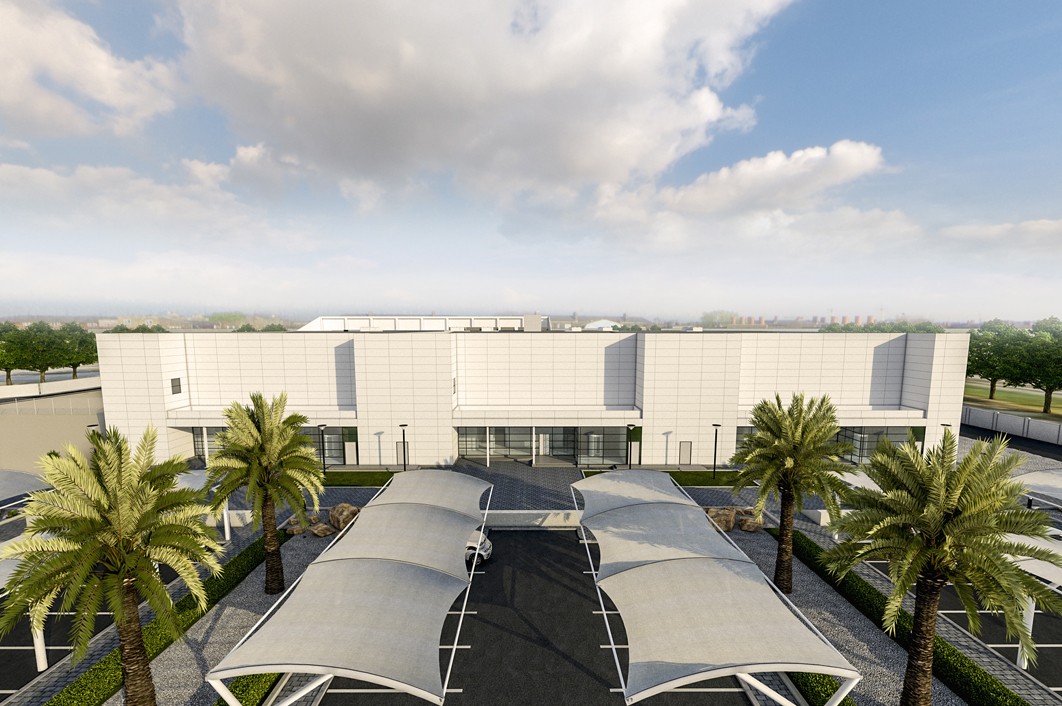

Achieving data supremacy requires more than just technological innovation; it requires strategic investments in infrastructure, talent, and policy. Governments must prioritize the creation of high-performance data centers that can support the demands of AI, machine learning, and real-time decision-making. Additionally, collaboration between the public and private sectors will be essential to ensure that data infrastructure meets both national security and commercial needs.
Investment in skilled talent will also be crucial. Building and maintaining next-generation data infrastructures requires expertise in fields such as nuclear energy, AI, cybersecurity, and agile software engineering. Public-private partnerships can facilitate this process by providing funding, resources, and expertise to support the rapid development and deployment of new technologies.
Challenges and Risks
The promise of nuclear-powered, GPU-optimized data centers comes with significant challenges and risks that must be addressed to realize their potential. Energy independence through nuclear power is a double-edged sword—while it ensures resilience against traditional power grid vulnerabilities, it also introduces security risks, including potential cyberattacks targeting nuclear systems. Advanced safeguards will be essential to protect both the physical and digital components of these infrastructures from sabotage, espionage, or catastrophic failure. Moreover, the high costs of nuclear technology and GPU deployment could limit accessibility, potentially widening the gap between technologically advanced nations and those without the means to invest.

Data governance is another critical issue in this evolving paradigm. As data centers become more integrated into global strategies, ensuring the authenticity, security, and ethical use of data will be paramount. The reliance on AI and machine learning to analyze massive datasets introduces risks of bias, errors, and misuse, particularly in high-stakes applications like military decision-making or critical infrastructure management. Establishing international standards for data interoperability, classification, and ethical AI usage will require unprecedented collaboration among governments, private sector players, and international organizations. Without these safeguards, the benefits of advanced data centers could be undermined by mistrust and misuse.
Finally, environmental and societal impacts must not be overlooked. While nuclear power offers a cleaner alternative to fossil fuels, managing nuclear waste and ensuring long-term sustainability remain unresolved challenges. Furthermore, the rapid expansion of data centers could exacerbate existing inequalities, concentrating power and resources in a few nations or corporations. Addressing these risks will demand forward-thinking policies, robust public-private partnerships, and a commitment to balancing innovation with equity. As nations and enterprises rush to secure their place in the data supremacy race, they must confront these challenges head-on to build systems that are not only powerful and efficient but also secure, ethical, and inclusive.
Roadmap to the Future of Data Supremacy
The race for data supremacy is not just about technological breakthroughs—it’s about creating ecosystems that can adapt and evolve in an ever-changing landscape. To achieve this, nations and enterprises must prioritize interoperability and collaboration, breaking down silos between allies, industries, and technologies. A unified data architecture, such as a data fabric that spans diverse systems and formats, will be critical for enabling seamless data sharing and real-time decision-making. Leveraging public-private partnerships, governments can tap into the agility and innovation of the private sector while ensuring national security priorities are maintained.

Equally important is the need to attract and cultivate talent capable of building and managing these advanced infrastructures. The development of nuclear-powered, GPU-optimized data centers requires expertise in fields ranging from nuclear engineering to AI and data science. Governments and industries must invest in education, training, and recruitment programs to bridge the talent gap, ensuring that the workforce can meet the demands of this emerging paradigm. By fostering a culture of innovation and cross-sector collaboration, nations can accelerate the deployment of cutting-edge data solutions while building resilience against potential adversaries.
Policy and strategy will play pivotal roles in shaping the future of data supremacy. Governments must create frameworks that incentivize innovation, support sustainable practices, and establish clear guidelines for ethical AI and data governance. At the same time, they must address the geopolitical implications of advanced data centers, from securing supply chains for critical technologies to navigating the complex dynamics of international competition and cooperation. The road ahead is challenging, but by embracing bold strategies and forward-thinking solutions, nations can position themselves to lead in the digital age, harnessing the power of data to drive progress, security, and prosperity on a global scale.
Conclusion: Preparing for the Future of Data Warfare
As the world becomes more interconnected and data-driven, the nations that lead in the development of advanced data infrastructures will have a distinct advantage in both military and economic spheres. By integrating AI, GPU-optimized data centers, and sustainable energy solutions, the U.S. and its allies can position themselves to dominate the data race. However, achieving this will require overcoming significant challenges, including interoperability, cybersecurity, and data governance.
The ability to control and process data will increasingly determine the outcomes of conflicts and shape global power dynamics. The next phase of technological development must prioritize the creation of resilient, secure, and scalable data architectures that can support the future of warfare, business, and international relations. As nations around the world race to achieve data supremacy, the stakes have never been higher, and the time to act is now.
Sources, Acknowledgements and Image Credits
{1} Data Center Warfare | The Race to Data Supremacy. Image credit: PWK International Advisers
{2} Race to data supremacy, Deterrence. Image credit: PWK International Advisers
{3} A Brief History of Data Centers. Source, Data and Image credit: PWK International Advisers
{4} Data Fabric in Defense & Intelligence | Defense Simulation Analytical Service | Source: IBM Consulting | Red Hat. All trade marks and trade names are the property of the respective owners.
{5} Aerial view of Equinix DC11 data center in Ashburn, Virginia. Image Credit: Getty Images
{6} Todays Cloud Services Providers: Innovations and Sustainability. Source, Data and Image credit: PWK International Advisers. All trade marks and trade names are the property of the respective owners.
{7} Machine learning and deep learning unlocks data to identify patterns, predict outcomes and make automated decisions. Image credit: U.S. Army Training and Doctrine Command, Army Futures.
{8} Geopolitics of Data Supremacy. Image credit: PWK International Advisers
{9} Global Data Powerhouses: The World’s Most Influential Data Centers. Source, Data and Image credit: PWK International Advisers. All trade marks and trade names are the property of the respective owners.
{10} Cybersecurity and Data Privacy. Spy vs. Spy is a wordless comic strip published in Mad magazine. The spies were created by late Cuban expatriate cartoonist Antonio Prohías. Image credit: Mad Magazine 1961
{11} Building the Infrastructure for Data Supremacy. Caption: United Arab Emirates G42 merge data center services under Khazna Data Centers, to migrate kingdoms cloud computing systems to Microsoft Azure. The announcement was made during GITEX GLOBAL 2024. Image credit: Core42
{12} Roadmap to the Future of Data Supremacy. Image credit: PWK International Advisers
About PWK International Advisers
PWK International provides national security consulting and advisory services to clients including Hedge Funds, Financial Analysts, Investment Bankers, Entrepreneurs, Law Firms, Non-profits, Private Corporations, Technology Startups, Foreign Governments, Embassies & Defense Attaché’s, Humanitarian Aid organizations and more.
Services include telephone consultations, analytics & requirements, technology architectures, acquisition strategies, best practice blue prints and roadmaps, expert witness support, and more.
From cognitive partnerships, cyber security, data visualization and mission systems engineering, we bring insights from our direct experience with the U.S. Government and recommend bold plans that take calculated risks to deliver winning strategies in the national security and intelligence sector. PWK International – Your Mission, Assured.


















 pwkinternational.com
Pingback: Weaponizing Reality |
Pingback: Made In China | AI Chips in Great Power Competition |