

The legal and policy frameworks that guide the use of military force by the United States have evolved over time to address a wide spectrum of threats, ranging from terrorism and traditional armed conflicts to the increasingly significant realm of cyber warfare. Central to this evolution are the 2001 Authorization for Use of Military Force (AUMF), the application of international law in cyberspace, and the constitutional dynamics between Congress and the President regarding the deployment of armed forces. These frameworks collectively shape the United States’ approach to modern security challenges while balancing legal, ethical, and political considerations. This report aims to explore these aspects in depth, highlighting their origins, challenges, and ongoing developments, and examining their implications for both domestic and international security.
Key Frameworks and Authorities
The 2001 AUMF was enacted in response to the September 11 terrorist attacks, representing a pivotal moment in U.S. legislative history. This authorization granted the President the power to use military force against those responsible for the attacks, including groups like Al-Qaeda and their supporters. Over time, the application of this law has expanded to include military actions against various groups and entities deemed as affiliates or successors to Al-Qaeda, such as the Taliban and, more controversially, ISIS. For example, U.S. drone strikes in Yemen have targeted members of Al-Qaeda in the Arabian Peninsula (AQAP), an organization considered an offshoot of the original Al-Qaeda network.
Similarly, military operations in Somalia have focused on Al-Shabaab, a group with ideological ties to Al-Qaeda. Perhaps the most debated expansion occurred during the Obama Administration, which justified military actions against ISIS in Iraq and Syria under the 2001 AUMF, arguing that ISIS evolved from Al-Qaeda in Iraq, despite the groups’ later disassociation. This broad application has extended to regions like Libya and Pakistan, highlighting the evolving interpretation of “associates” and the geographic flexibility granted by the AUMF. This broad interpretation has allowed successive administrations to conduct military operations in regions far beyond Afghanistan, including Pakistan, Yemen, Somalia, and Syria. However, this flexibility has drawn significant criticism, with many arguing that the AUMF has been stretched far beyond its original intent. These criticisms have fueled debates about the need to repeal, amend, or replace the authorization to better align it with contemporary threats.
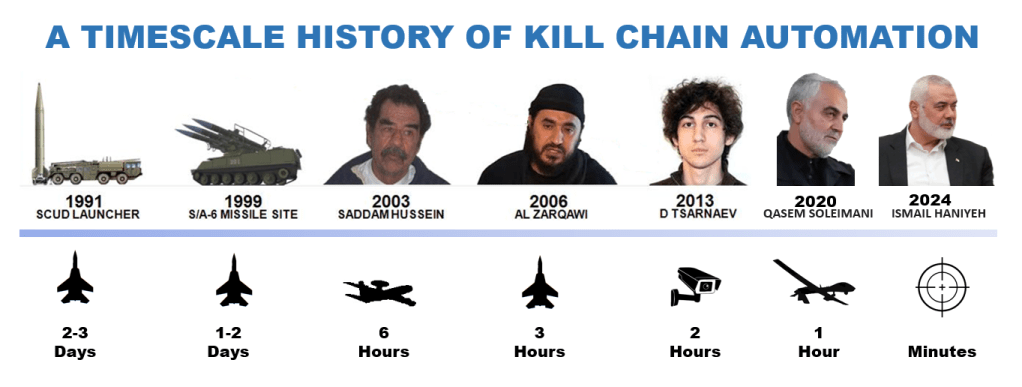
Chart depicts time scale compression due to advancements in automation of advanced kill chains. Finding targeting and destroying a Scud launcher in the early 1990's could take days. Todays advanced kill chains are more efficient due to digitization, machine to machine transfer and overall less latency in intelligence collection, processing and dissemination (PED) through systems like Maven, DCGS and JADC2. Source: PWK International Advisers.
In the domain of cyberspace, the lack of universally accepted definitions for concepts such as “armed attack” has created substantial challenges for the application of international law. The United States has taken the position that cyber activities causing significant physical destruction, injury, or death may be considered acts of war equivalent to traditional armed attacks.
However, the precise boundaries of this definition remain unclear. For example, while an attack on critical infrastructure like power grids or water systems might be classified as a use of force, other disruptive cyber activities, such as data theft or misinformation campaigns, often fall into a legal gray area. International frameworks, including the Tallinn Manual and principles outlined in the UN Charter, provide some guidance but lack binding authority. The U.S. government has emphasized the importance of existing legal frameworks and the establishment of norms to govern state behavior in cyberspace, underscoring the urgency of addressing these ambiguities.
Constitutionally, the power to engage in war is shared between Congress and the President, reflecting the Framers’ intent to balance the risks of executive overreach and legislative inertia. Article I grants Congress the authority to declare war, raise and support armies, and regulate the military, while Article II designates the President as Commander-in-Chief. This division creates a dynamic and often contentious relationship, particularly when rapid responses are required. The War Powers Resolution (WPR) of 1973 sought to clarify this balance by requiring the President to obtain congressional approval for military engagements lasting more than 60 days, except in cases of direct attacks on the United States. Despite its intent, the WPR has often been circumvented or interpreted flexibly, leading to ongoing debates about its efficacy and relevance in modern conflicts.


Challenges and Controversies
One of the most significant challenges arising from these frameworks is the expanding interpretation of the 2001 AUMF. Originally designed to target those directly involved in the September 11 attacks, the AUMF has been used to justify military operations in countries and against entities far removed from its initial scope. This expansion has prompted concerns about executive overreach and the erosion of congressional oversight. Critics argue that this broad application has effectively enabled the executive branch to conduct “forever wars” without adequate legislative or public accountability. Proposals to address these issues often emphasize the need for clearer language, geographic limitations, and sunset clauses to ensure that future authorizations remain aligned with their original objectives.
Cyber warfare adds another layer of complexity, as the attribution of attacks and the proportionality of responses remain contentious issues. The covert nature of cyber operations often makes it difficult to determine the origin of an attack or whether it constitutes an act of war. For example, cyber incidents like interference with election systems or the theft of sensitive information may not cause immediate physical damage but can undermine national security and democratic institutions. The principles of necessity and proportionality, which are central to traditional warfare, become more challenging to apply in the digital realm. Furthermore, the risk of collateral damage, such as unintended impacts on civilian infrastructure, complicates efforts to establish clear rules of engagement.


Domestically, the use of military forces under legal provisions such as the Insurrection Act and the Posse Comitatus Act highlights tensions between federal and state authority. While the Insurrection Act allows for federal intervention in cases of insurrection or obstruction of the law, its invocation is rare and often controversial. The Posse Comitatus Act, which restricts the use of military forces for domestic law enforcement, further underscores the importance of maintaining a clear distinction between military and civilian roles. However, exceptional cases, such as the 1992 Los Angeles riots, demonstrate the challenges of balancing these principles during crises.
Recent Developments and Proposals
Recent years have seen growing momentum for reforming the 2001 AUMF. Successive administrations have acknowledged the need to modernize or repeal the authorization to reflect the shifting nature of global threats. Proposed reforms aim to establish clearer objectives, geographic boundaries, and reporting requirements to enhance transparency and accountability. For example, legislative efforts have sought to sunset the AUMF after a specified period, ensuring regular reassessment of its necessity and scope.


In the realm of cyber strategy, the United States has made significant strides in advancing international norms and cooperative frameworks. The International Cyberspace & Digital Policy Strategy emphasizes collective security, confidence-building measures, and adherence to international law. By working with allies such as NATO, the U.S. seeks to harmonize responses to cyber threats and ensure that Article 5 commitments extend to digital attacks. This approach underscores the importance of multilateral efforts in addressing the challenges of cyberspace governance.
Additionally, Congress has mandated greater transparency in the legal and policy frameworks governing military operations. Recent reporting requirements compel the President to detail the legal justifications for ongoing and future military engagements. This transparency not only reinforces checks and balances but also fosters public trust by ensuring that military actions are consistent with U.S. values and international commitments.

For a comprehensive deep dive into the policy frameworks for the use of Lethal Autonomous Weapon Systems, please see:
LAWS of War. A Concise Guide to DoD Policy on Lethal Autonomy
Top Takeaways
The 2001 AUMF remains a cornerstone of U.S. counterterrorism policy but has faced significant criticism for its expansive interpretation and prolonged application. Cyber warfare presents unique challenges, including issues of attribution, proportionality, and the application of international law. The constitutional separation of powers aims to balance legislative and executive authority, but ongoing disputes highlight the need for clearer guidelines. Efforts to reform the AUMF focus on aligning its scope with contemporary threats while enhancing congressional oversight. Adherence to international norms and collaborative frameworks is vital for addressing cyber conflicts and maintaining global stability. Finally, legislative measures such as the War Powers Resolution and recent reporting requirements underscore the importance of accountability in military engagements.
Conclusion
The legal and policy frameworks governing the use of military force by the United States reflect a complex interplay of historical precedents, constitutional mandates, and evolving security challenges. While the 2001 AUMF provided a vital tool for responding to post-9/11 threats, its prolonged and expanded use underscores the need for reform. Similarly, the rise of cyber warfare demands innovative approaches to legal and strategic governance, as traditional concepts of warfare are increasingly tested in the digital age.


As the United States navigates future challenges, collaborative efforts at both domestic and international levels will be crucial. By embracing transparency, accountability, and multilateral cooperation, the nation can adapt its defense strategies to safeguard peace and security in an increasingly interconnected and complex world.
Reforming these frameworks is not only a matter of legal necessity but also a commitment to upholding democratic principles and international leadership. By striking a balance between agility and accountability, the United States can ensure that its military actions align with both national interests and global norms. This balance is essential for maintaining public trust and reinforcing the rule of law in addressing contemporary conflicts.
Additional Information:

Acknowledgements and Image Credits
{1} Forever Wars and the Authorization for use of Military Force. Image Credit: Undisclosed
{2} A Time Scale History of Kill Chain Automation. Source and Credit: PWK International Advisers
{3} Top ten forever wars because of AUMF. Source and Credit: PWK International Advisers
{4} Cyber Attacks that changed everything. Source and Credit: PWK International Advisers
{5} Recent developments and proposals. Image Credit: US Central Command. US Central Intelligence Agency (CIA).
{6} Conclusion. Image Credit: ISIS, Al Qaeda, Undisclosed
About PWK International Advisers
PWK International provides national security consulting and advisory services to clients including Hedge Funds, Financial Analysts, Investment Bankers, Entrepreneurs, Law Firms, Non-profits, Private Corporations, Technology Startups, Foreign Governments, Embassies & Defense Attaché’s, Humanitarian Aid organizations and more.
Services include telephone consultations, analytics & requirements, technology architectures, acquisition strategies, best practice blue prints and roadmaps, expert witness support, and more.
From cognitive partnerships, cyber security, data visualization and mission systems engineering, we bring insights from our direct experience with the U.S. Government and recommend bold plans that take calculated risks to deliver winning strategies in the national security and intelligence sector. PWK International – Your Mission, Assured.

















 pwkinternational.com
Pingback: Drugs, Guns & Drones: An Addicts Guide to Cartels |
Pingback: Are You A Terrorist? |