
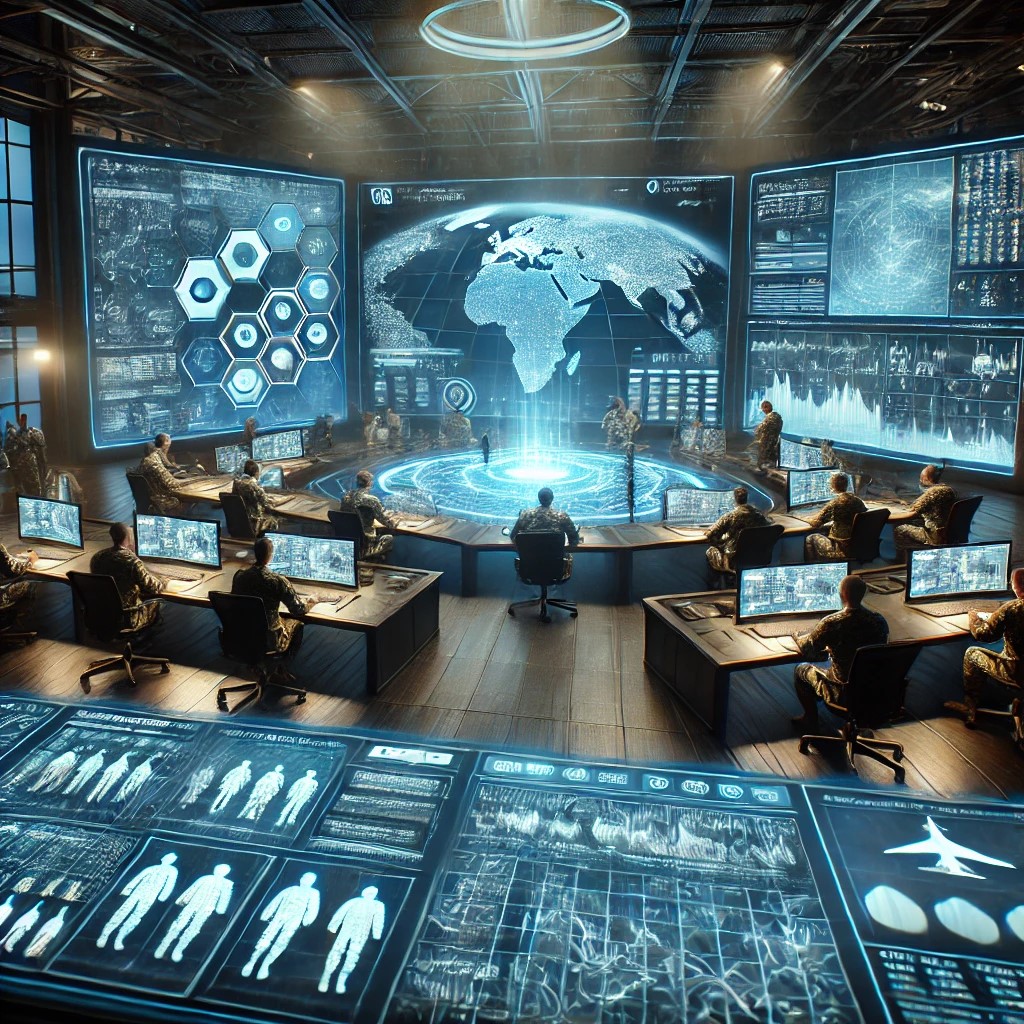
Command and Control in the Age of AI – The modern battlefield is no longer just about tanks, planes, and ships — it is a data-driven domain where speed, precision, and connectivity determine victory. With adversaries rapidly advancing their own capabilities, the United States and its allies are undergoing a significant transformation in command and control (C2) systems to ensure seamless coordination across land, sea, air, space, and cyberspace. From artificial intelligence (AI)-powered decision-making to real-time data fusion from satellites, drones, and sensors, warfare is shifting toward an era where information dominance is as critical as firepower. In this high-stakes environment, Joint All-Domain Command and Control (JADC2) and similar international initiatives are at the heart of military modernization efforts.
This report aims to explore the most cutting-edge C2 systems being developed to enhance situational awareness, accelerate decision-making, and integrate forces across multiple domains. The U.S. military’s advancements, including the Air Force’s Advanced Battle Management System (ABMS), the Army’s Project Convergence, and the Navy’s Project Overmatch, illustrate a concerted effort to replace outdated, siloed communication structures with AI-driven, networked solutions. Allied nations, from NATO to Australia, are also investing in their own JADC2-like programs to ensure interoperability and maintain technological parity with potential adversaries. As AI, cloud computing, and sensor integration become the foundation of modern warfare, command and control systems are evolving to keep pace with the rapid flow of battlefield data.
At the core of this transformation is the ability to process and act upon vast amounts of information in real-time. Systems like Project Maven leverage machine learning to analyze battlefield imagery, while Anduril Industries’ Lattice AI platform enables autonomous decision-support for distributed operations. The U.S. Navy’s Aegis Combat System is being modernized to integrate with next-generation networks, ensuring that missile defense, fleet coordination, and air superiority operate as a unified system. These developments underscore a shift from reactive, human-led command structures to AI-augmented decision-making that can anticipate threats and orchestrate responses at machine speed.
However, the transition to fully networked warfare is not without challenges. Integrating these technologies across different military branches and allied forces requires overcoming interoperability issues, cybersecurity threats, and ethical considerations surrounding AI-driven targeting. While the promise of JADC2 and similar systems is to create a battlefield where every sensor, weapon, and warfighter is interconnected, the reality of implementation remains complex. As this report will illustrate, the modernization of battlefield command and control represents both an unprecedented opportunity and a formidable challenge in the future of warfare.

Chapter One: The Evolution of Battlefield Command and Control
For centuries, military command and control (C2) relied on direct human leadership, messenger-based communication, and rudimentary signals to coordinate forces. From the ancient battlefield formations of Rome to the extensive use of telegraphs in the American Civil War, commanders have always sought faster, more reliable ways to direct their troops. The 20th century saw the rise of radio communications, radar, and centralized command posts, enabling nations to wage increasingly complex wars. However, as conflicts became more technologically sophisticated, traditional C2 systems struggled to keep pace with the sheer volume of information and the speed at which decisions needed to be made. The advent of digital warfare, cyber operations, and artificial intelligence (AI) has driven a fundamental shift in how militaries approach command and control.
Today, modern battlefield C2 is defined by its ability to integrate data from multiple sources in real time. Joint All-Domain Command and Control (JADC2) is a direct response to the growing need for military forces to coordinate across land, air, sea, space, and cyberspace. The traditional model of independent service branches operating their own systems is no longer viable in an era where threats move fluidly across domains. Adversaries have developed advanced electronic warfare capabilities, hypersonic missiles, and AI-driven cyber attacks that require a level of coordination that legacy systems simply cannot provide. JADC2 and similar initiatives from allied nations are built on the principle of data fusion—connecting every sensor, platform, and weapon system into a unified network to provide commanders with a clear, up-to-the-second picture of the battlespace.
The shift toward AI-driven decision-making represents one of the most significant advancements in military C2. The U.S. Department of Defense has invested heavily in programs like Project Maven, which uses machine learning to analyze intelligence data at machine speed, reducing the time required for threat identification. Meanwhile, the Air Force’s Advanced Battle Management System (ABMS) and the Army’s Project Convergence are leveraging cloud computing, automation, and AI to enable instant communication between aircraft, ground forces, and naval assets. These efforts signal a move toward an increasingly autonomous battlefield, where human commanders are supported by AI-enhanced decision-making tools that can anticipate enemy movements and recommend optimal responses in real-time.
However, the integration of these systems is not without challenges. Many military platforms were designed in an era before data-driven warfare, leading to interoperability issues that must be addressed through extensive software upgrades and network redesigns. Additionally, the increased reliance on AI and cloud-based systems raises concerns about cybersecurity, as sophisticated adversaries will seek to disrupt, manipulate, or disable these networks. Ethical considerations surrounding autonomous decision-making in combat also remain a pressing issue, as militaries must establish clear policies on human oversight in AI-driven warfare. Despite these obstacles, the modernization of battlefield C2 is an unavoidable necessity, as the nature of warfare continues to evolve in an age where information dominance can be as decisive as firepower.


Chapter Two: The Technologies Powering Modern Command and Control
The foundation of modern command and control (C2) lies in its ability to rapidly collect, process, and distribute data across multiple domains. To achieve this, the U.S. military and its allies are leveraging a suite of advanced technologies, including artificial intelligence (AI), cloud computing, edge processing, and next-generation communications networks. These technologies work together to transform how battlefield decisions are made, ensuring that commanders can act with greater speed and precision. At the heart of this transformation is Joint All-Domain Command and Control (JADC2), which seeks to eliminate stovepiped systems and create a seamless network where information flows instantly between air, land, sea, space, and cyber assets. This shift represents a fundamental break from traditional C2 models that relied on hierarchical, human-driven decision-making processes.
One of the most important advancements in C2 technology is the development of AI-driven decision support systems. Project Maven, one of the earliest Pentagon AI initiatives, has demonstrated how machine learning can analyze massive amounts of intelligence, surveillance, and reconnaissance (ISR) data in real time. Similarly, Anduril Industries’ Lattice system uses AI to autonomously detect and track threats, reducing the cognitive load on human operators. By integrating AI into C2, militaries can accelerate target identification, predict enemy movements, and automate routine battlefield decisions, allowing human commanders to focus on higher-level strategy. However, while AI enhances battlefield awareness, it also introduces new challenges, such as ensuring algorithmic reliability, avoiding adversarial manipulation, and maintaining human oversight in lethal decision-making.
Cloud computing and edge processing are also revolutionizing how militaries handle data. The U.S. military’s shift toward a cloud-based infrastructure enables real-time information sharing across branches and allied forces, making JADC2 a reality. Programs like the Advanced Battle Management System (ABMS) and Project Convergence rely on cloud-native architectures that allow for dynamic data distribution and computational power at the tactical edge. Edge processing, in particular, reduces reliance on centralized data centers by allowing battlefield devices—such as drones, ground vehicles, and warships—to process and analyze data locally. This reduces latency and ensures that critical battlefield information remains accessible even in contested environments where network connectivity may be limited.
Next-generation communications networks, including 5G and low-Earth orbit (LEO) satellite constellations, play a crucial role in enabling real-time C2 capabilities. Traditional military communications systems often struggled with bandwidth limitations, particularly in high-intensity operations where vast amounts of sensor data need to be transmitted. With the integration of 5G and advanced satellite networks, JADC2 systems can support high-speed, low-latency communications across all military domains. Companies like SpaceX, OneWeb, and Lockheed Martin are developing resilient satellite architectures to provide global coverage, ensuring that warfighters remain connected even in denied or degraded environments. Together, these technologies form the backbone of modern C2, enabling a level of speed, integration, and decision-making superiority that was previously unattainable.

Chapter Three: Integrating Multi-Domain Operations
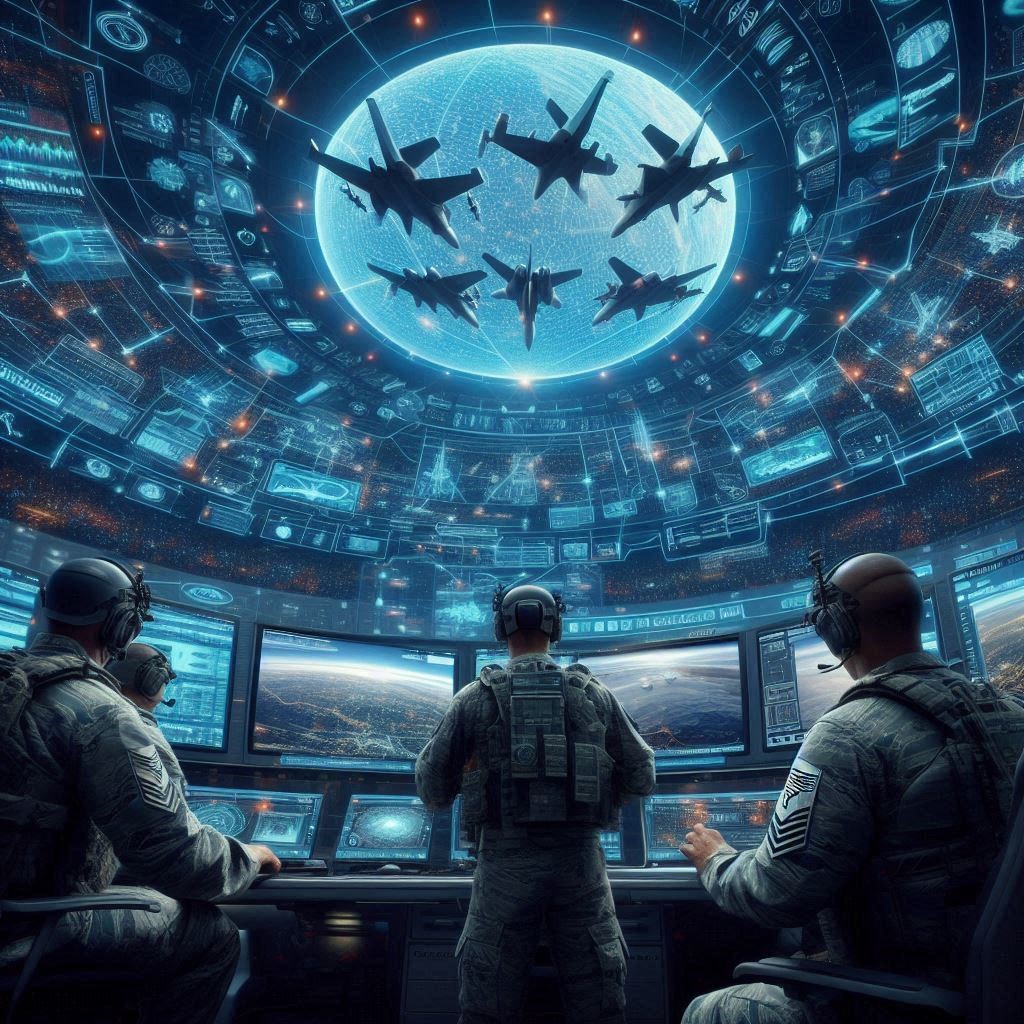
The concept of multi-domain operations (MDO) is at the core of modern battlefield command and control (C2), enabling military forces to seamlessly operate across land, air, sea, space, and cyberspace. Traditional warfare relied on distinct, service-specific operations with limited coordination between branches. However, emerging threats—such as hypersonic missiles, cyber warfare, and electronic jamming—demand a more integrated approach where all domains work together in real time. Joint All-Domain Command and Control (JADC2) is designed to break down these barriers, ensuring that intelligence gathered from one domain can instantly inform decision-making in another. By integrating MDO into modern warfare, militaries can create a highly adaptable and responsive force capable of countering both conventional and asymmetric threats.
A critical aspect of multi-domain integration is sensor fusion, which connects data from satellites, aircraft, ground sensors, and naval platforms into a single, unified network. The U.S. military’s Advanced Battle Management System (ABMS) is leading this effort by using AI and cloud computing to process and distribute sensor data across the Air Force, Army, and Navy. Similarly, the Navy’s Project Overmatch is developing new networking technologies to enable distributed maritime operations, allowing warships, submarines, and unmanned vehicles to share real-time targeting data. Meanwhile, NATO allies are working on their own MDO initiatives, such as the UK’s Defence Digital Strategy and Australia’s Joint Fires Network, which aim to integrate allied forces into a unified C2 framework. These programs reflect a growing recognition that no single branch—or even nation—can dominate future conflicts without real-time, cross-domain coordination.
The modernization of C2 systems also requires overcoming significant interoperability challenges. Many current military platforms were designed as stand-alone systems with proprietary software, making it difficult to integrate them into a larger network. The U.S. Department of Defense is addressing this issue by adopting open architecture frameworks, which allow new and legacy systems to communicate through standardized interfaces. One example is the Integrated Air and Missile Defense Battle Command System (IBCS), which enables disparate missile defense platforms to function as a single, cohesive network. By creating an open, modular C2 infrastructure, militaries can ensure that their forces remain flexible and adaptable as technology continues to evolve.
Despite these advancements, integrating MDO into military operations is not without risks. The reliance on AI-driven decision-making and cloud-based networks introduces new vulnerabilities, particularly in the form of cyber threats and electronic warfare attacks. Adversaries such as China and Russia are actively developing capabilities to disrupt, jam, or manipulate military networks, posing a serious challenge to JADC2’s effectiveness. To counter these threats, the U.S. and its allies are investing in hardened, resilient communication architectures that can operate in degraded environments. Ultimately, while multi-domain integration offers unparalleled advantages in speed and situational awareness, its success depends on the ability to secure and defend the underlying networks that make it possible.


Joint All-Domain Command and Control (JADC2) is a U.S. Department of Defense initiative aiming to integrate sensors, shooters, and data across all military domains to enhance decision-making and operational effectiveness. Several U.S. military branches and allied nations have developed similar systems to achieve integrated command and control capabilities.
| Advanced Battle Management System (ABMS) – U.S. Air Force: ABMS is the Air Force’s contribution to JADC2, designed to create a network-centric approach that connects sensors and shooters across all domains, enabling faster decision-making and improved situational awareness. |
| Project Convergence – U.S. Army: This initiative aims to integrate the Army’s weapons, sensors, and data into a unified network, enhancing the speed and accuracy of decision-making on the battlefield. |
| Project Overmatch – U.S. Navy: Focused on developing a networked maritime operations capability, Project Overmatch seeks to connect platforms, weapons, and sensors to enhance distributed maritime operations. |
| Integrated Air and Missile Defense Battle Command System (IBCS) – U.S. Army: IBCS is a command-and-control system designed to integrate air and missile defense systems into a unified network, allowing for more effective and coordinated defense operations. |
| NATO Air Command and Control System (ACCS) – NATO: ACCS is designed to integrate air operations across NATO member nations, providing a unified approach to air command and control within the alliance. |
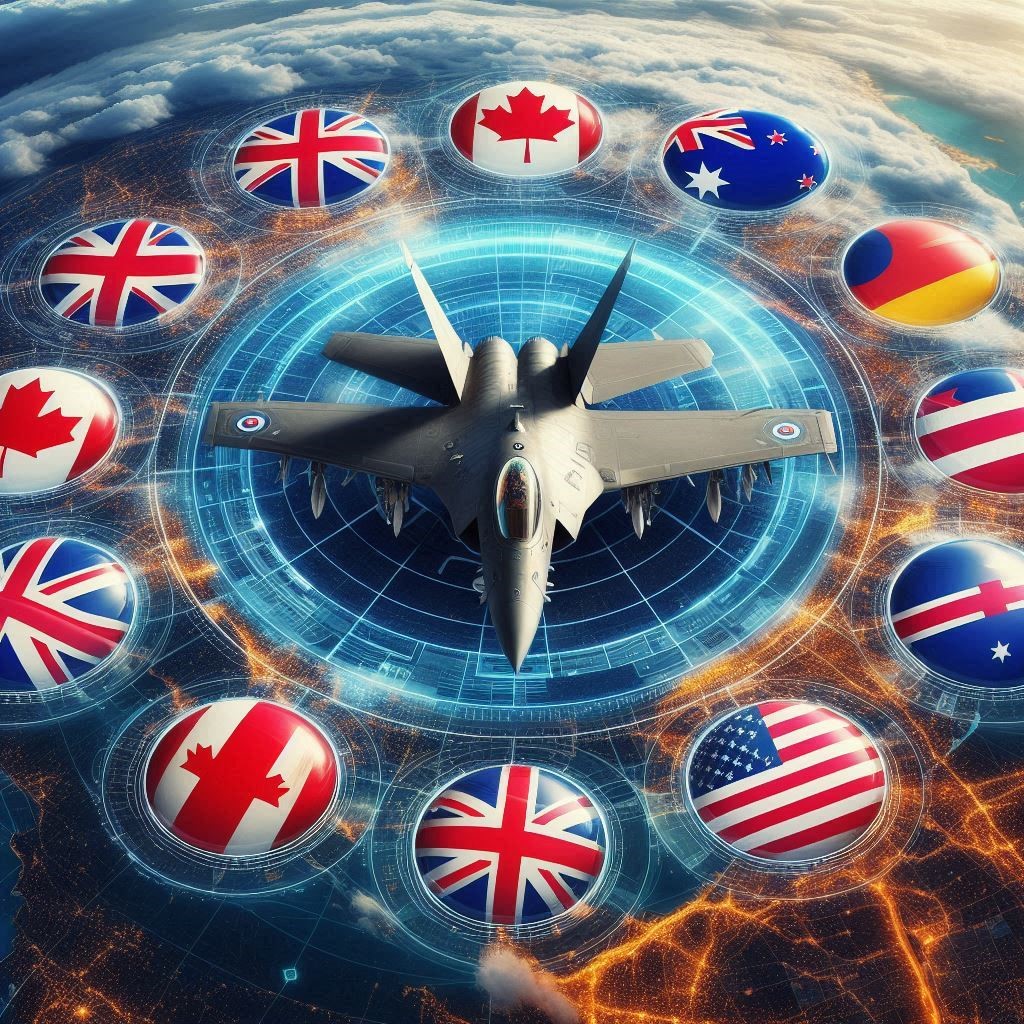
| Five Eyes Air Force Interoperability Council (AFIC) – Australia, Canada, New Zealand, United Kingdom, United States: AFIC aims to enhance interoperability among the air forces of the Five Eyes nations, focusing on collaborative command and control capabilities. |
| Defence Command Paper Initiatives – United Kingdom: As part of its Defence Command Paper, the UK is investing in multi-domain integration to enhance command and control across its armed forces, aligning with JADC2 principles. |
| Joint Fires Network (JF-NET) – Australia: JF-NET is an Australian Defence Force initiative to integrate sensors and shooters across domains, improving targeting and situational awareness. |
| NORAD Command and Control – United States and Canada: The North American Aerospace Defense Command (NORAD) employs integrated command and control systems to defend North American airspace, exemplifying bi-national cooperation. |
| Combined Joint All-Domain Command and Control (CJADC2) – U.S. Department of Defense: CJADC2 represents the DOD’s effort to deliver an initial iteration of a combined joint all-domain command and control capability, aiming for integrated operations across all military branches and allied forces. |
Chapter Four: The Role of Artificial Intelligence in Command and Control
Artificial intelligence (AI) is rapidly transforming the way militaries process information, make decisions, and conduct operations. Traditional command and control (C2) structures relied on human analysis of intelligence data, often leading to delays in decision-making. AI-powered systems, such as Project Maven and Anduril’s Lattice, now allow for real-time data analysis, automatically identifying threats, tracking enemy movements, and recommending optimal responses. These AI-driven decision-support tools not only reduce the cognitive burden on human operators but also enable faster, more precise battlefield coordination. As AI continues to advance, its role in modern warfare will only grow, potentially leading to a future where autonomous systems handle routine decision-making while human commanders focus on broader strategic objectives.
One of AI’s biggest advantages in C2 is its ability to predict enemy behavior and optimize force deployment. Machine learning models, trained on historical combat data and real-time intelligence feeds, can detect patterns and anticipate adversary actions with greater accuracy than human analysts alone. AI is also playing a critical role in automating sensor fusion, synthesizing information from satellites, drones, cyber networks, and battlefield units into a single, actionable intelligence picture. Systems like the Advanced Battle Management System (ABMS) leverage AI to distribute this intelligence instantaneously across multiple military branches, ensuring that commanders and warfighters at every level have access to the same real-time data.
However, the growing reliance on AI-driven C2 introduces significant challenges. Machine learning algorithms can be vulnerable to adversarial attacks, where enemy forces attempt to manipulate AI models by feeding them misleading data. Additionally, ethical concerns arise regarding the role of AI in lethal decision-making—should machines be allowed to make life-and-death calls on the battlefield without human oversight? To address these concerns, the U.S. and allied militaries are developing strict protocols for human-in-the-loop (HITL) oversight, ensuring that AI serves as an assistant rather than an autonomous commander. While AI offers tremendous advantages in speed and efficiency, its full integration into battlefield C2 will require balancing technological capabilities with security, ethics, and strategic control.

Chapter Five: Cybersecurity and the Vulnerabilities of Networked Warfare
As modern command and control (C2) systems become more dependent on AI, cloud computing, and real-time data sharing, they also become increasingly vulnerable to cyberattacks. The shift toward Joint All-Domain Command and Control (JADC2) and similar systems means that military networks must handle vast amounts of sensitive information across interconnected platforms. While this connectivity enhances operational efficiency, it also presents a significant attack surface for adversaries looking to disrupt, degrade, or manipulate military decision-making. State-sponsored cyber forces from China, Russia, Iran, and North Korea have already demonstrated their ability to infiltrate and compromise critical defense networks, raising concerns about the security of next-generation C2 infrastructure.
One of the most significant threats to networked warfare is electronic warfare (EW) and cyber sabotage. Adversaries are developing advanced capabilities to jam communications, inject false data into military networks, and exploit vulnerabilities in AI-driven systems. A compromised AI model, for example, could misidentify threats or provide inaccurate battlefield assessments, leading to disastrous consequences. To counter these risks, the U.S. Department of Defense and its allies are investing in cyber-resilient architectures, implementing zero-trust security models, and developing AI-driven cyber defense tools to detect and neutralize attacks in real time. Additionally, redundancy measures, such as hardened satellite networks and alternative communication channels, are being designed to ensure that critical battlefield operations can continue even if primary networks are compromised.
Another key challenge is securing the supply chain of military software and hardware. Many modern C2 systems rely on commercially available components, making them susceptible to hidden backdoors, firmware exploits, or embedded malware. The SolarWinds hack, which compromised multiple U.S. government agencies, highlighted the risks of supply chain infiltration and demonstrated how adversaries can exploit weaknesses in software updates to gain access to classified networks. To mitigate these risks, defense contractors and military agencies are implementing strict vetting processes, increasing investments in domestically produced technology, and deploying AI-driven anomaly detection tools to monitor network integrity. However, as military systems become more digitized, ensuring their security will require continuous innovation and proactive defense strategies.
Despite these risks, the benefits of networked warfare and AI-driven C2 far outweigh the challenges, provided that cybersecurity remains a top priority. Future battlefields will be shaped by the ability to collect, process, and act on information faster than the enemy, making secure, resilient communication networks essential for operational success. The ongoing race between cyber offense and defense will continue to evolve, with militaries constantly adapting to new threats. By integrating cybersecurity into the foundation of JADC2 and similar systems, the U.S. and its allies can ensure that the advantages of modern command and control are not undone by the vulnerabilities of an increasingly digital battlespace.


Chapter Six: The Future of Command and Control
The modernization of command and control (C2) is an ongoing process, driven by the rapid evolution of technology and the ever-changing nature of warfare. Future battlefields will demand even greater levels of automation, interoperability, and resilience, requiring militaries to continue integrating artificial intelligence (AI), quantum computing, and advanced networking technologies into their operations. The next generation of JADC2-like systems will likely feature fully autonomous battlefield assistants capable of analyzing vast amounts of data, predicting enemy actions, and coordinating multi-domain operations with minimal human input. As these technologies mature, the role of human commanders may shift from direct tactical decision-making to higher-level strategic oversight, ensuring that AI-driven systems remain aligned with mission objectives and ethical constraints.
One of the key challenges in the future of C2 will be maintaining seamless interoperability among allied nations. As the U.S. military and its partners develop their own versions of JADC2, ensuring that these systems can communicate and operate as a cohesive network will be essential for global security. Efforts such as NATO’s Federated Mission Networking initiative and Australia’s Joint Fires Network are already working to standardize data-sharing protocols and integration frameworks. Additionally, advancements in space-based communications and low-Earth orbit (LEO) satellite constellations will further enhance global connectivity, allowing allied forces to maintain persistent situational awareness even in contested environments. However, as adversaries develop countermeasures such as cyber weapons and electronic warfare capabilities, ensuring the resilience of these networks will remain a top priority.
Ultimately, the future of C2 will be defined by the ability to balance technological innovation with security, adaptability, and human oversight. While AI and autonomous systems promise to revolutionize battlefield decision-making, their effectiveness will depend on rigorous testing, ethical safeguards, and the ability to operate in the face of cyber threats and electronic warfare. The race for information dominance is accelerating, and the militaries that can best harness emerging technologies while mitigating their risks will hold the strategic advantage. As JADC2 and similar initiatives continue to evolve, they will shape not just the future of warfare, but the broader geopolitical landscape of the 21st century.

Top Six Takeaways
- Integration is Key to Modern Warfare – The shift from isolated, branch-specific command structures to fully integrated, multi-domain networks like JADC2 is essential for faster decision-making and battlefield coordination.
- AI is Revolutionizing Command and Control – Systems like Project Maven and Anduril’s Lattice are enhancing real-time data analysis, automating threat detection, and enabling predictive decision-making at machine speed.
- Cybersecurity is a Major Vulnerability – The growing reliance on digital networks and AI-driven decision-making increases the risk of cyberattacks, electronic warfare, and data manipulation by adversaries.
- Interoperability is a Challenge for Allies – Ensuring that U.S. and allied nations’ C2 systems can communicate effectively requires standardized protocols, secure data-sharing frameworks, and joint military exercises.
- Autonomy Must Be Balanced with Human Oversight – While AI-driven C2 improves efficiency, ethical and strategic concerns necessitate human-in-the-loop controls to prevent unintended consequences in autonomous decision-making.
- The Future Belongs to Those Who Dominate Information – The race for information superiority will define 21st-century warfare, and the militaries that best leverage AI, cloud computing, and resilient communication networks will hold the strategic advantage.

Conclusion
The modernization of battlefield command and control (C2) is fundamentally reshaping the way wars are fought, with artificial intelligence, real-time data fusion, and multi-domain operations at the forefront of military strategy. The transition from traditional, service-specific communication networks to fully integrated systems like JADC2 reflects the growing need for speed, precision, and interoperability in modern warfare. By leveraging AI-driven decision-making, cloud computing, and advanced sensor networks, the U.S. military and its allies are creating an operational environment where every sensor, platform, and warfighter is seamlessly connected. These advancements promise to revolutionize command structures, reduce decision-making time, and provide warfighters with a decisive information advantage on the battlefield.
However, with these advancements come significant challenges. The increasing reliance on AI and networked systems introduces new vulnerabilities, including cybersecurity threats, electronic warfare disruptions, and ethical concerns surrounding autonomous decision-making. Adversaries such as China and Russia are actively developing countermeasures to exploit weaknesses in digital warfare, making it imperative for allied militaries to invest in resilient, secure, and adaptable C2 systems. Additionally, ensuring interoperability among different branches of the military—and across allied nations—remains a complex challenge that requires continuous collaboration and standardization of technologies. Without addressing these concerns, the very systems designed to enhance military effectiveness could become liabilities in future conflicts.
Looking ahead, the future of C2 will be defined by how well nations can balance technological innovation with operational security and human oversight. AI-driven systems will continue to play an expanding role in command decision-making, but human leadership will remain essential in ensuring ethical and strategic alignment. As the U.S. and its allies refine and implement JADC2-like systems, they must remain focused on building adaptive, cyber-resilient infrastructures that can withstand emerging threats. Warfare is evolving at an unprecedented pace, and those who can most effectively integrate, protect, and leverage advanced C2 technologies will shape the geopolitical battlespace of the 21st century.
Additional Information

About PWK International Advisers
PWK International provides national security consulting and advisory services to clients including Hedge Funds, Financial Analysts, Investment Bankers, Entrepreneurs, Law Firms, Non-profits, Private Corporations, Technology Startups, Foreign Governments, Embassies & Defense Attaché’s, Humanitarian Aid organizations and more.
Services include telephone consultations, analytics & requirements, technology architectures, acquisition strategies, best practice blue prints and roadmaps, expert witness support, and more.
From cognitive partnerships, cyber security, data visualization and mission systems engineering, we bring insights from our direct experience with the U.S. Government and recommend bold plans that take calculated risks to deliver winning strategies in the national security and intelligence sector. PWK International – Your Mission, Assured.



















 pwkinternational.com
Pingback: Weaponizing Reality |