

The Untold Story of How the Military “Owns The Night” | The December 1989 American invasion of Panama ushered in a new set of war fighting guidelines brought about by the prolific use of night operations systems and doctrine. About 26,000 U.S. soldiers, Marines, and airmen simultaneously seized some twenty objectives while overhead, more than 100 U.S. aircraft sortied in and out of a tight, twenty-mile-radius area of operations. The whole complex undertaking was staged in the dead of night without lights. Operation Just Cause flagged a historic tactical turning point. From that time on, Western military forces were just as likely to attack by night as by day.

OPERATION
JUST
CAUSE
Deemed Too Risky
Throughout history, night attacks of any kind have been rare. The Bible records Gideon successfully leading a force of Israelites against the Midianite army in the twelfth century B.C. There are other Middle Eastern examples, and references to the utility of night attacks in ancient Asia, but few similar Western accounts. Homer pointed out that action in the dark commonly ended in chaos and disorder. Of the Peloponnesian wars, Thucydides said that “in a night engagement . . . who could be certain of anything?” Besides being risky, he wrote, night attacks were considered dishonorable.

Frederic The Great was a brilliant military strategist and leading figure of the “enlightened absolutism” movement in Prussia circa 1740 – 1786.
Frederick the Great stated: “I am determined never to attack by night, on account of the confusion that darkness necessarily occasions.” The duke of Wellington wrote, “I have come to the determination, when in my power, never to suffer an attack to be made at night upon an enemy who is prepared and strongly posted, and whose posts have not been reconnoitered by day light.” And that most celebrated interpreter of war, Carl von Clausewitz, noted, “Many schemes for night attacks [have been] put forward by those who have neither to lead them nor accept responsibility for them. In practice, they are rare.”
The Best Time to Storm The Redoubts
For the most part, night operations in the West were specialized tasks connected with sieges, happenstance, or occasional acts of desperation by relatively weak forces. Roman legions were famous for their ability to set up a barricaded camp by sunset, indicating that their barbarian enemies used nighttime assaults to offset inferiority in armament, discipline, or both. A force besieging a fortress would commonly establish a “night cordon”, a tighter perimeter around its target to prevent messengers, spies, or would-be attackers from eluding surveillance. In daylight, such closer positions would risk projectile attacks from fortress walls.

Redcoats from Lord Cornwallis 17th, 23rd Royal Welch Fusiliers, 33rd, 43rd, and 71st Highlanders Regiments defended against numerous Continental Army night attacks on redoubt number 10 at the Battle of Yorktown.
That is why the culmination of many sieges featured a night assault on the walls. As the October 1781 American and French seizure of Yorktown’s outlying redoubts proves, forces besieging an entrenchment could avoid a defender’s superior, close-in firepower by moving siege lines forward at night. A successful advance would allow attackers to bring up their own guns. Elsewhere, a nighttime approach might precede the usual dawn attack, but that march or the odd daytime attack that continued into darkness could not be called a proper night attack. What little Western respect night attacks might have earned was surely dashed in the era known as the “dawn of modem warfare”-a singularly apt term in these circumstances.
Perhaps the best nineteenth-century exception to the general rule about night attacks occurred during the American Civil War, thanks to two of the North’s most innovative generals, Major General James H. Wilson and Brigadier General Emory Upton. Wilson’sCavalry Corps, including Upton’s 4th Cavalry Division, moved on Georgia from Alabama in April 1865, heading for the arsenal at Columbus. (The war had just ended in Virginia, but here the Confederates were not ready to surrender.) About 3,000 Confederate troops and twenty-seven guns defended a bridge leading into the town.
Wilson and Upton decided to try a night attack on April 16. Well after dark, at 1630, 400 dismounted Union troopers crept toward the forward defenses. The Confederates heard them and fired; the troopers ran forward and captured these first positions. Two companies of Upton’s cavalrymen then rode through and, mistaken in the dark for retreating friendlies, were allowed to pass the main defensive line. They overpowered the bridge guards and took fifty prisoners. The Rebels quickly mounted an assault on the bridge, forcing the blue coats into a hasty retreat.

General Emory Upton was a Union Army officer known for his bravery and innovative tactics during the Civil War, particularly for his successful infantry assaults on fortified positions.
Undeterred, Wilson and Upton pressed a new regiment forward. Despite vicious fire, it broke open another path, and then a third regiment, this one dismounted, attacked the bridge. So determined were the onrushing Federals that the thoroughly shaken defenders were forced to give way once again and were soon engulfed. Unable to tell friend from foe, Rebels near the bridge could not assist the fleeing defenders. The tide of Union attack carried not only the bridge, but the town of Columbus itself. At dawn, Upton rounded up 1,200 prisoners, sixty three artillery pieces, the six-gun Confederate ship Jackson, fifteen locomotives, tons of ammunition, and 250 pieces of rail stock. There were 300 confederates killed and wounded; Upton’s losses were only 5 killed and 28 wounded. His night attack was virtually the last big land action of the American civil war.
Turn On The Lights
During World War I, Western armed forces increasingly used darkness. In 1915, the Kaiser’s Zeppelins staged nighttime bombing sorties over England; ground forces used the cover of darkness to conduct trench raids, taking prisoners and discovering enemy defenses. And round-the-clock German U-boat attacks took a growing toll of Allied shipping. Actions sparked reactions: the use of powerful searchlights to target Zeppelins and spot submarines; the development of star shells and parachute flares to provide illumination without revealing the firer’s position; and the creation of underwater hydrophones, facilitating day and night attacks on submarines. But large-scale infantry night attacks had an indifferent record. For example, at Festubert, France, in May 1915, German searchlights and star shells illuminated British troops as they crossed no-man’s land, and machine guns stopped them.

While Western sailors and airmen planned to expand their use of darkness after the war, their ground compatriots were cautious. When the U.S. Army Infantry School conducted a study of World War I tactical combat operations in the 1930s, it devoted only 6 percent of its coverage to night attacks. The authors said the tactic offered a means to cross an area otherwise denied by enemy fire in daylight. But they warned about the extraordinary difficulties of control and the need for special training and discipline. They concluded that night attacks had to be of short range, carefully planned, conducted by fresh, well-trained troops, and aimed at easily defined objectives.
Sun Tzu Says . . .
In the East, the approach to night ground attacks was more enthusiastic, even before World War I. By the late 1920s, Japanese army leaders decided to emphasize them. They figured their relative inferiority in mechanized forces and artillery and their presumed superiority in close-in fighting would make night offensives a winning tactic.

Japanese soldiers press forward a night attack at Guadalcanal. Suicidal night attacks and banzai charges became commonplace in observation of the “Bushido Code” of no surrender.
Most of their initial World War II offensives were carried out at night and most succeeded, but when the Japanese ran into determined American resistance on Guadalcanal and New Guinea, their nighttime elan proved no match for U.S. firepower. But even at the end of the war the Japanese were still resorting to the tactic.
While Allied air and naval services increased their nighttime offensive prowess during World War II, ground commanders held back. The Battle of EI AIamein, which featured repeated night attacks, was a notable exception. Only a few selected U.S. ground units, such as the 1st and 104th U.S. infantry divisions in Europe and some of General Douglas A. MacArthur’s units in the latter phases of the Philippines campaign were noted for this capability.

Pathfinders of the American XVIII Airborne Army prepare to jump into Normandy France.
Perhaps the best American night attackers were the airborne, Ranger, and Office of Strategic Services (OSS) combat units. These specialized units, often thrust into enemy territory, were accustomed to being initially out manned and outgunned. They balanced such temporary disadvantages by attacking at night and defending during daylight. There are few more celebrated examples than the D-Day night drop of the Allied XVIII Airborne Corps parachutists.
I Think I Can See You
These programs were of minor import during the Vietnam War. Searching for an elusive enemy in dense jungle was hard enough in daylight and nearly impossible at night. So daylight attacks remained the staple for U.S. ground forces. But the Vietcong and North Vietnamese insisted on night attacks and the Americans were quite willing to accommodate them.
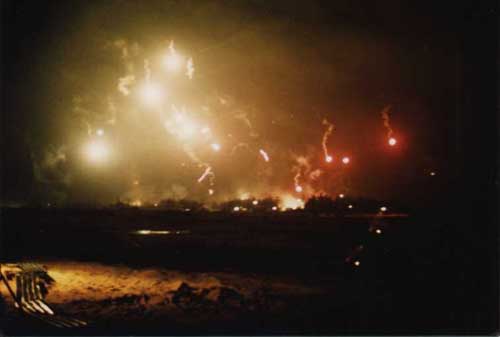
An NVA night attack is illuminated by star shell bursts.
The usual result was a stack of attackers’ bodies on the defender’s barbed wire at sunrise. Meanwhile, the U.S. improved night-vision equipment and intensified night training. A radically improved night-attack proficiency for U.S. ground forces was gradually developed after the Korean War. In Korea, Chinese and North Korean infiltration, logistical movement, and tactical attacks were habitually conducted in the dark. Frustrated by the apparent loss of initiative at night, the U.S. Army began remedial programs under two former World War II airborne commanders, Generals Matthew B. Ridgeway and Maxwell D. Taylor.

NVA soldiers advance through dense jungle by way of riverine waterways during a night attack on US forces in Vietnam.
Both of these army chiefs of staff had commanded troops in Korea. Regular combat-arms officers were encouraged to volunteer for Ranger training, a sixty-day course featuring almost forty-five consecutive nights of patrolling in varied terrain. The graduates stressed night-attack training in the units they commanded afterward. At the same time, the army spent hundreds of millions of dollars developing night-vision devices: infrared sights, thermal imaging equipment, and passive night-vision goggles.
By the late 1970s, all these programs bore fruit. A large percentage of regular infantry, artillery, and armor officers were graduates of the Ranger course; units were spending increasing training time at night; and thoroughly tested, reliable, and relatively lightweight night vision equipment began entering the inventory. When the XVIII Airborne Corps was called on to oust General Manuel Noriega from power in Panama, the U.S. Army had as much skill in night attacks as the U.S. Air Force. This skill gives a Western military force an automatic advantage over a less sophisticated adversary-as would again be proven during the present conflicts in southwest Asia.

U.S. Army Lt. Col. Jack Marr, commander of 1st Battalion, 15th Infantry Regiment, 3rd Heavy Brigade Combat Team, 3rd Infantry Division, checks his night vision on Combat Outpost Carver, Iraq, prior to a night air assault mission.
Detection Technology Revolution
Since the mid-1970’s, the ability to see in the dark without radiating a signal to adversaries has dramatically increased the DoD’s investment in electro-optic (EO) systems. In the last decade, the increased affordability of these rapidly evolving technologies has re-shaped numerous acquisition programs and spawned entirely new ones as well (see figure one). Covering a wide swath of the electromagnetic spectrum, infrared (IR), thermal imaging (TI), solid-state lasers, and sophisticated optics with charge coupled devices (CCD’s) have brought dramatic new capabilities to the war fighter from sub-sea to on orbit. The resolution clarity of surveillance imagery has increased to a level not previously thought possible, and has begun to influence tactical war fighting doctrine. At the same time, a remarkable decrease in the size, weight, cooling engine and power consumption requirements of these systems has made them more ubiquitous than ever as they permeate across the joint and coalition battle space in an array of networked sensor suites.
As the performance and interoperability of these sensors increases, the military is increasing their integration with semi-autonomous and autonomous air vehicles, weapon systems and AI powered command and control (C2).
Next Generation Night Vision

A US Army UH-60 Black Hawk Helicopter of the 1st Infantry Division prepares for a night mission in Iraq.
As night operations in Iraq, Afghanistan, Syria, Jordan, Yemen and other global hot spots have become commonplace, the military is responding to the need to equip as many soldiers as possible with the means to “see” in the dark through the efforts of the US Army’s Night Vision and Electronic Sensors Directorate (NVESD). The night vision goggle (NVG) has emerged as mission critical kit for ground based troops that require either monocular or binocular capability.
The heart of any night vision apparatus is the combination of optics and the image intensification tube (II). These devices are being fielded as stand-alone NVG’s, hand-held devices or accessories to weapons sights. To give a sense of the initial scale of deployment, the US military purchased more than 150,000 AN/PVS-7 series (third generation) NVG. The leading producers of NVG include Excelis (formerly ITT Night Vision of Roanoke, VA) and Northrop Grumman (following an acquisition of Rolling Meadows IL based Litton Industries Optical Systems), amongst others.

Raytheon, an RTX business, has further enhanced its semiconductor foundry’s process for producing military-grade Gallium Nitride, known as GaN. The improved GaN performs better and costs less than previous versions. Credit: Raytheon
Driven by demand to improve clarity through an increase in signal-to-noise ratio, industry took on an ambitious next generation solution through a teaming effort with Lawrence Livermore Laboratories. This effort has resulted in the fielding of revolutionary digital fusion units that deliver images that can be combined, stabilized, projected and transmitted. These third generation NVG also use a photocathode that is coated with sensitive gallium arsenide, allowing for a more efficient conversion of light to electrical energy at extremely low light levels.
Beyond the Dark — The New Battle for Night Dominance
AI & Sensor Fusion in the Night Battlespace
Over the past decade, the rise of AI/ML and improved computing payloads has enabled sensor fusion at the tactical edge. Modern systems routinely combine thermal, low-light, radar, lidar, and multispectral imagery to generate a more robust “night picture” than any single modality could provide. Autonomous drones can conduct low-altitude night reconnaissance, use onboard inference engines to flag suspected targets, and feed collated data into command networks in near real time. These capabilities accelerate the OODA loop in darkness and shift the equation of surprise.
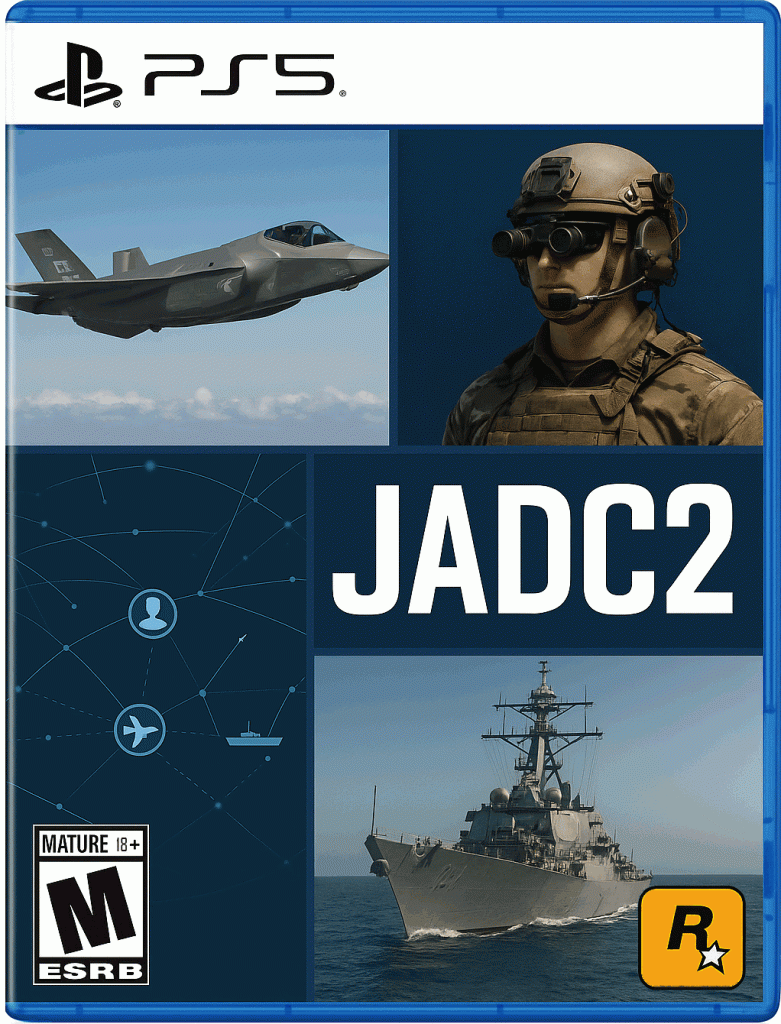
“In the Air Force, 86% of Airmen and Guardians Identify as Gamers.”
Using commercial off-the-shelf controllers such as PlayStation and Xbox is significantly cheaper than developing new specialized human interface military hardware.
Source: US Air Force
Electromagnetic & Spectrum Warfare in Darkness
Night operations do not take place in silence or invisibility — the electromagnetic environment is alive. Jamming, spoofing, directed energy, IR dazzlers, signature morphing, and electronic deception become essential tools to contest sensor superiority. An adversary need not illuminate the battlefield visually if they can disrupt or deceive your thermal sensors or blind your optics. The side that controls or corrupts the spectral domain may “own the night” even without physically seeing.

A standard Carrier Air Wing (CVW) is equipped with one Electronic Attack Squadron (VAQ), which consists of seven EA-18G Growler Electromagnetic Spectrum Attack Aircraft.
Denial, Deception & Countermeasures
As sensing technologies grow more capable, new means of denial and deception emerge. Adaptive camouflage materials, dynamic thermal coatings, infrared signature masking, decoy heat sources, and even sensor “fog” (IR-obscurant aerosols) can mislead enemy systems. Hacking or injecting false imagery feeds into optical sensor pipelines becomes a real threat: a sophisticated hacker might corrupt sensor data before it ever reaches the human operator.
Urban Night: Complexity Amplified
In modern urban terrain, night becomes more than absence of light — it is a maze of thermal emitters (vehicles, HVAC units, neon signs), unpredictable shadows, reflections, and clutter. Discrimination between combatants and noncombatants is harder. Moreover, ambient lighting, stray IR sources, and heat signatures from civilian infrastructure challenge the clarity of night vision systems. Successful urban night operations demand advanced filtering, context awareness, and tight mission planning.

Urban terrain presents unique challenges for dismounted infantry and crew served weapons prosecuting their brand of fighting on night missions.
Lessons from Recent Conflicts
Examples from Syria, Ukraine, and other theaters show how drones, thermal imaging, and counter-drone methods are shaping night ops today. In the Russo-Ukrainian conflict, both sides employ thermal UAVs, electronic warfare, and IR countermeasures to contest night reconnaissance and targeting. These real-world engagements prove that the concepts outlined above are not speculative — they’re already in play.

Anduril’s new Eagle Eye helmet is redefining modern combat technology with AI, augmented reality, and integrated sensors working together in real time while syncing with Anduril’s AI powered Lattice network.
Looking to the Horizon: Quantum, Human-Machine Teaming & Ethics
Quantum sensors, LiDAR in darkness, single-photon cameras, and advanced algorithms promise to redefine “seeing in the dark.” Coupled with augmented reality systems that overlay sensor fusion outputs onto operator goggles, the battlefield may soon be literally “lit” by data. But with this power comes risk: autonomous targeting, sensor hacking, privacy issues, attribution, and legal/ethics questions demand doctrinal guardrails. In future conflicts, the battle for night supremacy may be as much about who controls the data and autonomy as who controls physical darkness.
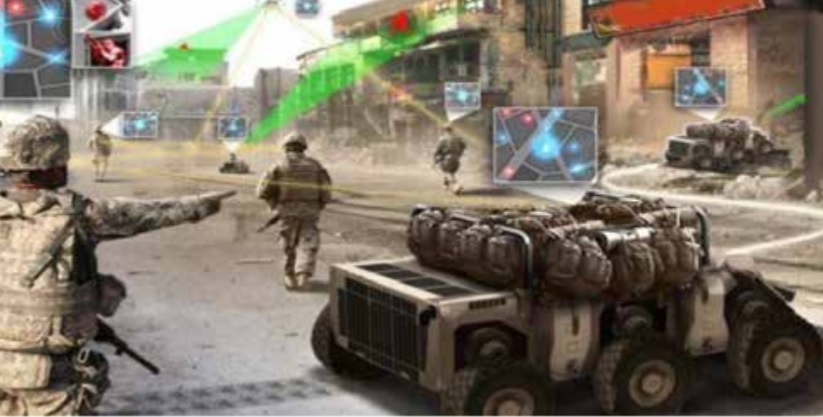
The battlefield of the future is about networks, data, edge sensing and algorithmically boosted OODA loops in a fight between an army of internet of things (IoT) controlled by human soldiers.
Strategic Implications & Doctrine Reset
To remain competitive, military forces should integrate “night+ spectrum+ data” thinking into doctrine, procurement, training, and operations planning. The advantage in future wars may lie not in being able to see when others cannot, but in being able to interpret, share, deny, and defend in the entire nocturnal battlespace.
As the pace of night vision technology accelerates, the war fighters’ fundamental ability to achieve the prime element of tactical surprise will help save lives while enabling the military to further “own the night”.
NOTICE: Our un-biased report includes mention of numerous nocturnal combat innovators and their night time battlefield surprise innovations. All registered trade marks and trade names are the property of the respective owners.

No part of this publication may be reproduced, stored in a retrieval system, or transmitted in any form or by any means—electronic, mechanical, photocopying, recording, scanning, or otherwise—without the prior written permission of the author, except in the case of brief quotations embodied in critical articles, reviews, or academic work, or as otherwise permitted by applicable copyright law.

"A Dark History of Nocturnal Combat" and all associated content, including but not limited to the report title, cover design, internal design, maps, engineering drawings, infographics and chapter structure are the intellectual property of the author. Unauthorized use, adaptation, translation, or distribution of this work, in whole or in part, is strictly prohibited.

This report is a work of non-fiction based on publicly available information, expert interviews, and independent analysis. While every effort has been made to provide accurate and up-to-date information, the author makes no warranties, express or implied, regarding completeness or fitness for a particular purpose. The views expressed are those of the author and do not necessarily represent the views of any employer, client, or affiliated organization.

All company names, product names, and trademarks mentioned in this report are the property of their respective owners and are used for identification purposes only. No endorsement by, or affiliation with, any third party is implied.
ABOUT COMPANIES MENTIONED IN THIS REPORT

Excelis (formerly ITT Night Vision / Exelis): A leading provider of night vision goggles, optics, and image intensification systems. They manufacture devices and components that convert low light into visible imagery for military and law enforcement use.

Northrop Grumman (including Litton Optical Systems / Litton Industries): A major aerospace and defense technology company that acquired Litton Industries. Its portfolio includes electronics, sensors, surveillance, systems integration, and mission systems. In the context of night vision, they now house optical and electro-optic capabilities once associated with Litton.

Litton Industries: Formerly a diversified high-technology company with divisions in electronics, optics, aerospace, navigation, and defense systems. It was acquired by Northrop Grumman and its electro-optical and optical systems contributions were absorbed into NG’s capabilities.

AOA Xinetics (a Northrop Grumman business unit): Specializes in advanced electro-optical, opto-mechanical, and adaptive optics systems. Their work focuses on high-performance sensors, deformable mirrors, precision actuators, and related optical technology for defense and commercial customers.

Morovision Night Vision: A U.S. distributor focused on providing night vision equipment — especially components and systems stemming from the legacy of ITT / Exelis — to law enforcement and commercial customers.

Sperry Marine (Northrop Grumman Sperry Marine): A maritime navigation and sensor systems company now under the Northrop Grumman umbrella. They produce navigation radar, compasses, integrated bridge systems, and marine sensors, supporting both defense and commercial maritime domains.

LITEF GmbH (Northrop Grumman LITEF): A German subsidiary focused on inertial navigation systems and sensors, particularly inertial measurement units (IMUs) and stabilization systems for air, land, and maritime platforms.

Raytheon (RTX) is a leading aerospace and defense company specializing in advanced technologies, including missile defense systems, radar, and cybersecurity solutions. With a strong focus on serving the U.S. Department of Defense and allied nations, Raytheon plays a critical role in enhancing global security and defense capabilities.

Anduril Industries in Costa Mesa California is a U.S. defense technology company that develops AI-powered autonomous systems, hardware, and software for military and national security applications. Founded by Oculus creator Palmer Luckey, it aims to modernize the military by building advanced, cost-effective systems like surveillance towers, unmanned aerial vehicles (drones), and underwater vehicles that work with its Lattice artificial intelligence software platform.

Microsoft is a multinational technology corporation known for a wide range of software, hardware, and services, including its Windows operating system, Microsoft Office, and Xbox gaming products. The Xbox game controller is the standard input device for Microsoft's Xbox consoles and PCs, featuring a recognizable ergonomic design with dual analog sticks, a D-pad, and face buttons.

Sony Group Corporation is a Japanese multinational conglomerate known for its diverse activities in electronics, gaming, and entertainment. Its PlayStation game controller provides an immersive gaming experience through features like haptic feedback, adaptive triggers, and a built-in microphone.
About PWK International Advisers
PWK International is a national security consulting and advisory firm serving clients across the defense, intelligence, and innovation ecosystem — including hedge funds, financial analysts, investment bankers, entrepreneurs, law firms, technology startups, private corporations, foreign governments, embassies, defense attachés, non-profits, and humanitarian aid organizations.
We help clients understand and anticipate the complex intersection of technology, policy, and strategy shaping the modern battlespace — from advanced sensing and surveillance to AI-driven decision systems and defense innovation pipelines. Our services include executive consultations, analytics and requirements definition, technology architectures, acquisition strategies, and best-practice blueprints that translate mission needs into competitive advantage.
Drawing from direct experience with the U.S. Government and defense industry, we deliver clarity where others see only complexity. Whether advising on cognitive partnerships, cybersecurity investments, or next-generation mission systems, PWK International provides bold, data-driven plans designed to mitigate risk and maximize opportunity in national security markets. PWK International — Your Mission, Assured.



















 pwkinternational.com
Warfare is a fascinating subject. Despite the dubious morality of using violence to achieve personal or political aims. It remains that conflict has been used to do just that throughout recorded history.
Your article is very well done, a good read.
Pingback: War’s Game-Changers: Technological Surprise in Great Power Competition |