Geopolitics is the new market signal in a world defined by accelerating change and persistent uncertainty. The next decade will not be shaped by a single conflict, theater, or adversary, but by those who achieve decision advantage through data, integration, and speed.
These ten hypothetical strategy games—games you wish you could buy—explore the “what if” of the decade ahead and model how power is already being contested: quietly, unevenly, and often outside the battlefield.
See if you meet the player requirements, have the necessary security clearance or if your computer has the right OS and enough disk space and ram. Wargame tomorrow and predict the future while shaping real outcomes today.
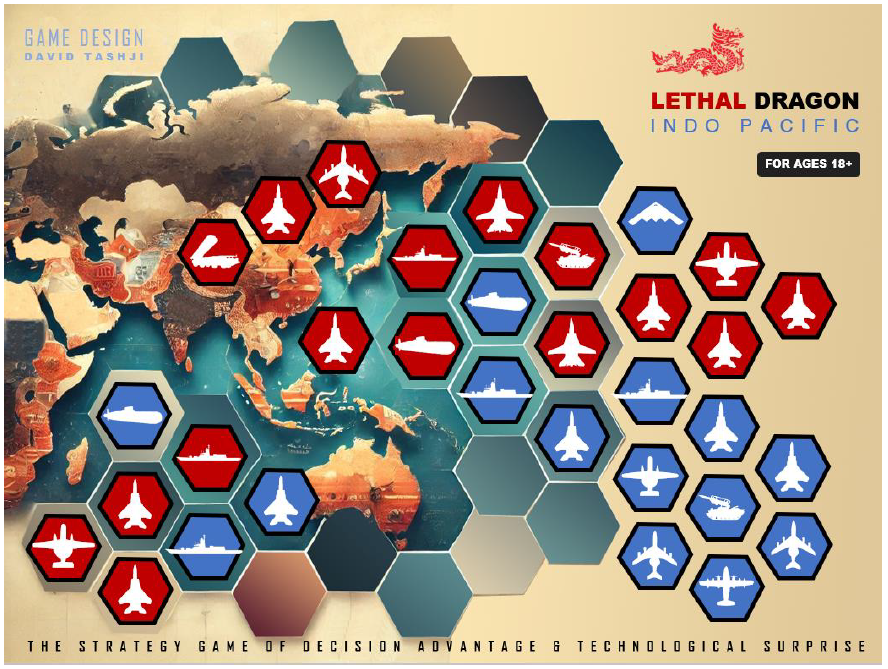
LETHAL DRAGON INDO PACIFIC | The Maritime Strategy Game of Decision Advantage and Technological Surprise
Lethal Dragon Indo-Pacific models great power strategic competition below the threshold of open war in the world’s most consequential theater.
Players confront gray-zone coercion, alliance signaling, maritime pressure, and escalation control across the Western Pacific. Military force is present and delivers decisive deterrence. Outcomes are shaped by information domination, team work, credibility, tempo, and restraint as much as by firepower.
The game exposes how easily miscalculation, domestic politics, and alliance friction can turn managed competition into irreversible conflict.
Players: 2–5 (China, Russia, United States, Regional Allies, Non-Aligned States and Non-State Actors)
Simulated Time: 1-4 years
Period Covered: Present day through early 2030s
Domains: Land Maritime Air Space Economic Cyber Information Politics
Key Technologies: ISR networks Anti-access A2AD Cyber operations Commercial shipping Undersea cables Data centers Space sensors
Gameplay: Hidden intent, Signaling mechanics, Escalation ladders, Irreversible thresholds, Alliance credibility, Burden-sharing tradeoffs
Core Tension: Winning without triggering a war no one can control
Scenarios: Carrier Clash 2028, Kurile Mist 2028, Guam 2029, South China Sea 2030, Philippines Archipelago 2028, Three Gorges Dam Taiwan, Cold Abraham Lincoln, No Drill Hainan 2030, RIMPAC 2030, Lethal Dragon Soaring Eagle Campaign 2025 – 2050

COCAINE CANAL | The Strategy Game of Global Shipping
Cocaine Canal reframes the drug war as a contest over ocean navigation, strategic choke points, sovereignty, logistics, regime change, narcotics trafficking and legitimacy.
Players navigate a world where criminal networks rival states in resources, intelligence, and influence. Strategic chokepoints—ports, canals, borders—become battlegrounds where corruption often outperforms force.
The game reveals how illicit economies destabilize regions while reshaping migration, governance, and security far beyond their origin.
Players: 2–6 (USA SOUTHCOM, DEA, ATF, vs. Cartels, Sinaloa, Jalisco CJNG, Juarez, Gulf, Los Zetas, Carribean, Central and South America Nation States and Guerilla Armies)
Simulated Time: 8 hour turns 1-year scenarios + full drug war campaign
Period Covered: Late 2010s–2030s
Domains: Land, Maritime, Economic, Trade, Information, Political
Key Technologies: Encrypted communications, logistics networks, undersea technology, money laundering schemas, drug subs, drones, weapon trafficking, gun boat diplomacy
Gameplay: Shadow economy mechanics / Corruption and legitimacy tracks / Narcotics trade and ocean cargo routes
Core Tension: Enforcement actions, naval blockades, carrier strike groups, nighttime airborne assaults, regime change
Scenarios: FARC Colombia 2030, Cuba 2027, Venezuela 2026, Panama 1989, President Rubio 2029, Fentanyl Canal 2026, Belt & Road 2026, Mexico Canal 2030, Tanker Takeover 2026, War on Drugs Campaign 2025-2035
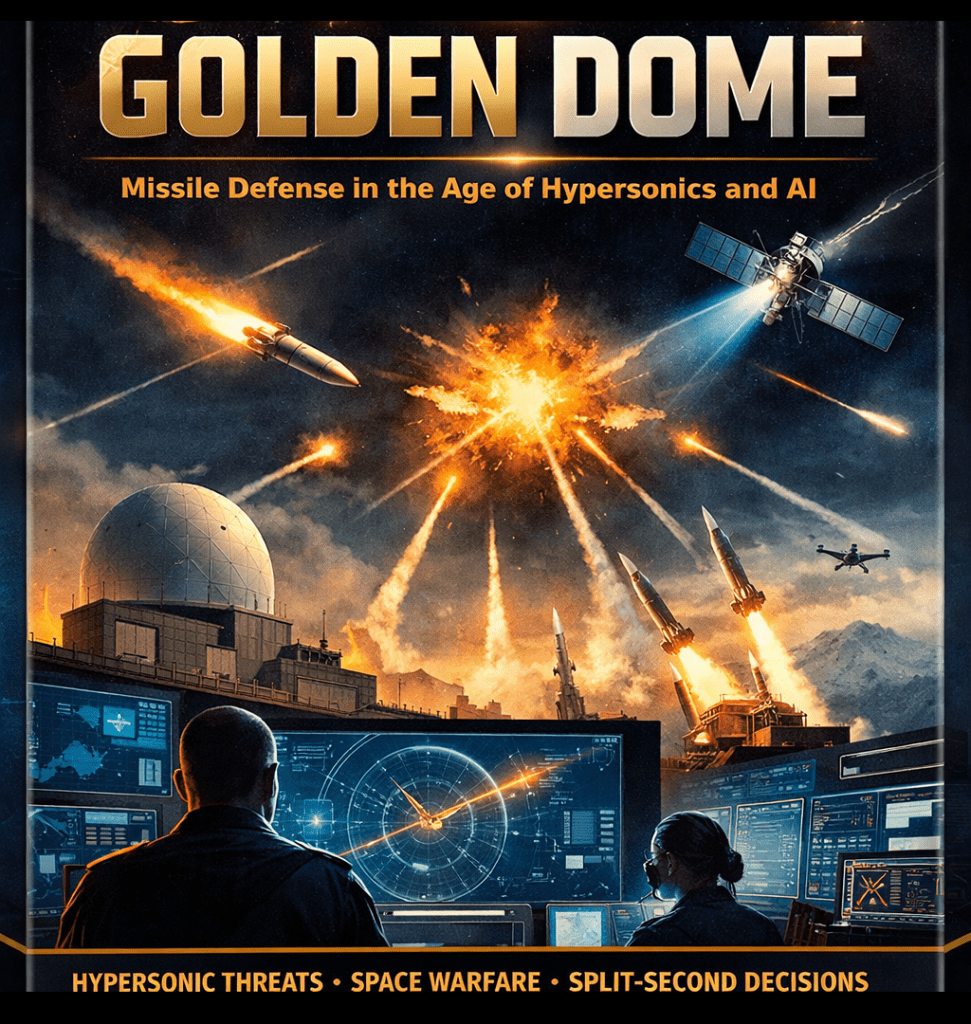
GOLDEN DOME | Weaponizing Space by 2030
Golden Dome is an AI agent computer strategy game that examines missile defense in an era defined by speed, ambiguity, and automation. Players manage sensor networks, interceptors, alliances, and decision timelines under extreme uncertainty.
The game emphasizes that missile defense is not a shield—it is a system whose weakest link determines its value. The central question is not whether missiles can be intercepted, but whether decisions can be made in time.
Players: 1–8 (USA, Canada, Greenland, Denmark, Russia, China, N Korea, Iran)
Simulated Time: 26 minutes – 1 day
Period Covered: Near-future (2025–2035)
Domains: Space, Air, Naval, Cyber, NC3 Command & Control
Key Technologies: AN/USQ 225, Hypersonics, space-based sensors, AI decision aids, integrated air defense, AEGIS, AN/SPY-6, SSBN, B2 Spirit, SBIR’s, E4B Looking Glass, Compass Call, Night Watch, THAAD, PATRIOT, MEECN, AEHF, SMART-T
Gameplay:
Time-compression mechanics
Human vs machine decision tradeoffs
Budget allocation across sensors, interceptors, diplomacy
Core Tension: Automation increases speed—and escalation risk
Player Requirements: Requires Common Access Card (CAC) Multi factor authentication with Top Secret SCI access to JWICS (Joint Worldwide Intelligence Communications System), NSA Net, GWAN NMIS NRO Management, SCION, SIPRNET (Secret Internet Protocol Router Network) NIPRNET (Non Classified Internet Protocol Router Network) and a SCIF.
System Requirements: El Capitan Livermore, Frontier Oak Ridge, Aurora Argonne, Athena NASA. Requires AMD Instinct MI300A Accelerated Processing Units (APUs), high speed interconnects (Infinity Fabric), liquid cooled server cabinets (HPE Cray EX4000 / Supermicro H13), high speed network adapters (Pensando 400 / Slingshot 11 / Mellanox NVIDIA ConnectX-7) and Gen5 NVMe SSDs. Not compatible with Windows 10 or Windows XP SP3.
Scenarios: V2 Big Apple 1945, Polar Frost 2027, Ocean War 2030, Cis Lunar Conquest 2028, October SSBN 2030, Force Elon 2028, Orion Conquest 2029, Far Side 2030, SBIR Eclipse Campaign 2025-2040, Space Superiority Campaign 2025-2050

SILENT DEPTHS | The Acoustical Game of Undersea Warfare
Silent Depths focuses on the undersea domain—the least visible yet most fragile layer of global power.
Players compete over submarines, seabed sensors, and undersea infrastructure that carries energy, data, and commerce. Actions are hard to detect, harder to attribute, and politically explosive once revealed.
The game exposes how modern societies depend on systems they barely defend.
Players: 2–5 (Naval Powers, Infrastructure Owners, Neutral States)
Simulated Time: 1–3 years + Campaign
Period Covered: Present–2040
Domains: Undersea, Maritime, Space, Cyber, Information
Key Technologies: Submarines, autonomous underwater vehicles, fiber-optic cables, seabed sensors
Gameplay:
Hidden movement and delayed attribution
Infrastructure vulnerability mapping
Escalation through ambiguity
Core Tension: Strategic effects without visible aggression
Scenarios: Baltic Eavesdrop 2024, Camp Smith Hawaii 2025, Guam and Tinian 2027, Woods Hole 2030, Cope Thunder 2028, Zero Day Norway, Irish Call Centers, Topaz Echo, Grace Hopper Marea, Wall Street 2028, Dunant Crossing, Atlantis Campaign 2025-2030.

RELOAD | The Industrial Base Optimization Game of the War Between the Factories
RE-LOAD models the struggle to re-arm industrial bases after decades of optimization for efficiency over resilience. Players confront labor shortages, supply chain fragility, political resistance, and time pressure as crises demand rapid production.
The game makes clear that declarations of resolve mean little without throughput. This is a war game where factories—not forces—determine outcomes.
Players: 2–4 (USA, NATO and Allies, China, Russia, N Korea)
Simulated Time: 1–50 years
Period Covered: 2020s–late 2030s
Domains: Industrial, Economic, Political
Key Technologies: Manufacturing automation, workforce training systems, logistics platforms, cultural transformation, additive manufacturing, advanced materials, rare earth mining
Gameplay:
Production capacity and workforce skill decay
Political will constraints
Stockpile vs surge tradeoffs
Core Tension: Mobilization that comes too late still fails
Scenario: Game is played as a campaign over decades
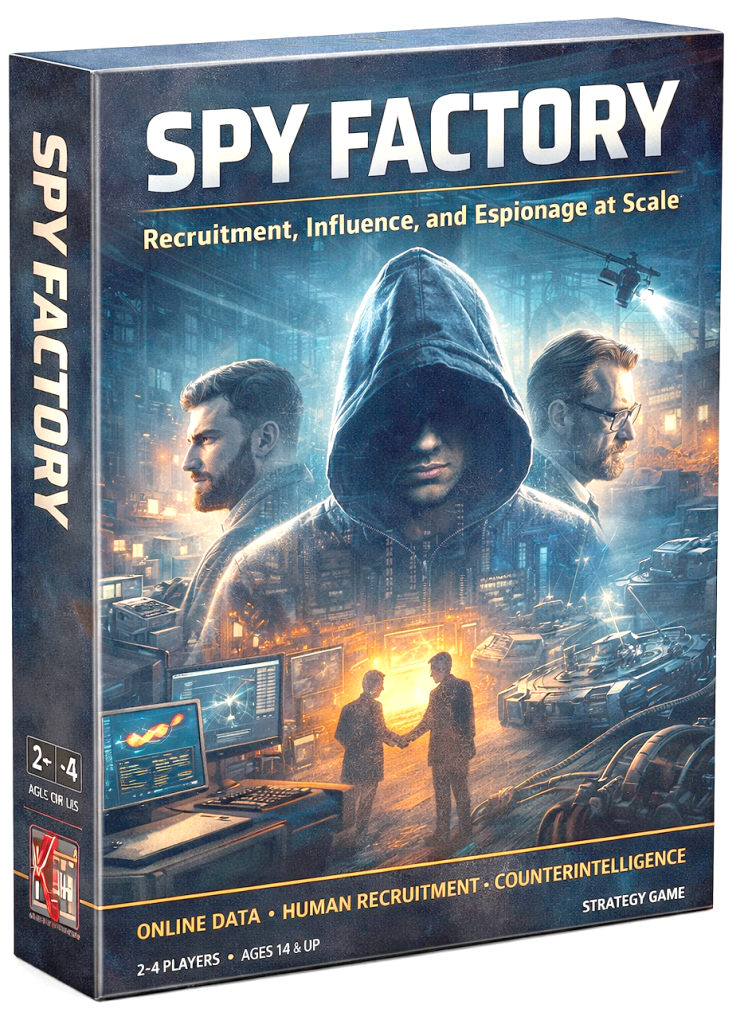
SPY FACTORY | Monetizing Espionage at Scale
Spy Factory models human intelligence recruitment in a world of pervasive digital exfiltration. Players compete to identify, recruit, protect, and exploit people and gain access to sensitive data and algorithms to short cut scientific discovery.
Social engineering, professional networks, supply chain trojans and data leaks collapse traditional tradecraft timelines. The game reveals how espionage has scaled—and how counterintelligence struggles to keep pace.
Players: 2–4 (Intelligence Services USA CIA, NSA, DHS, FBI, Russia KGB, China MSS, Israel Mossad, Japan, Germany, UK, India, Australia, Five Eyes Alliance)
Simulated Time: 1 month – 5 years
Period Covered: Post-2000 through near future
Domains: Human, Information, Cyber
Key Technologies: Data analytics, social platforms, surveillance tools
Gameplay:
Persona construction mechanics
Exposure and compromise risks
Long-term asset management
Core Tension: Visibility increases reach—and vulnerability
Scenarios: Thousand Talents 2026, China in New England 2025, China in Silicon Valley 2026, Russia Ballot Box 2024, Red Team Crypto, CIA Pandas 2030, Dead Drop Disguise, Double Agents Mini Campaign, Science War of the Century Campaign 1990 – 2050
Player Requirements: Psychological profiling and behavioral analysis, social engineering and persuasion, counterintelligence awareness, surveillance detection and evasion, disguise and identity management, secure communications discipline, cultural and linguistic fluency, risk assessment under uncertainty, ethical judgment in gray zones, and long-term asset management. Masters degree in Psychology.
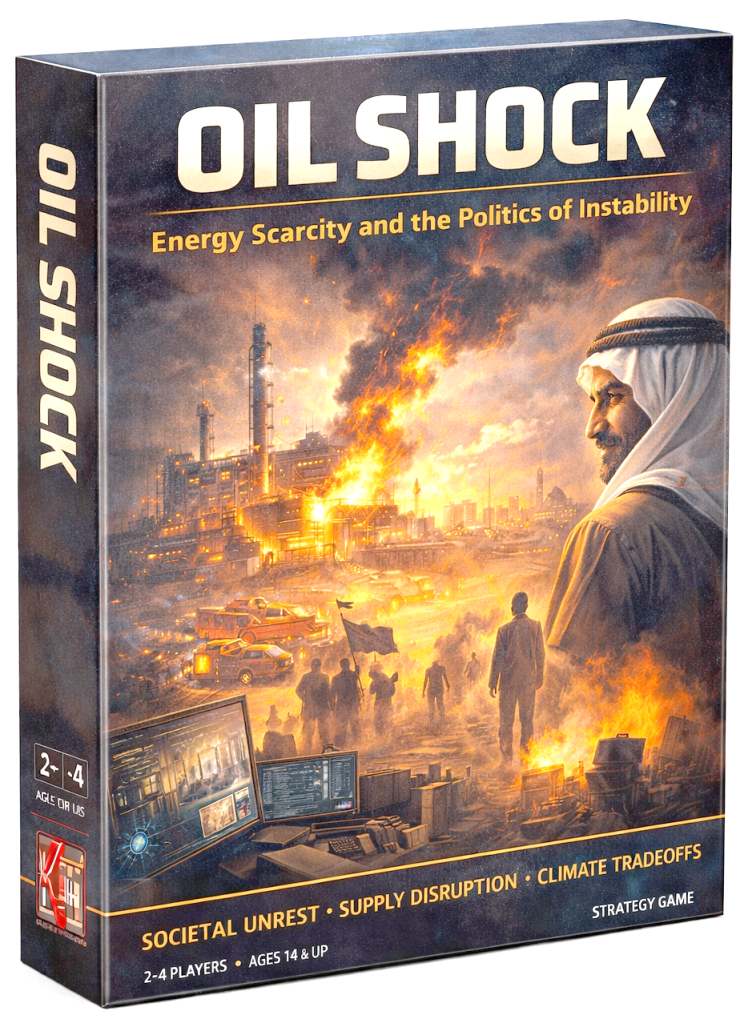
OIL SHOCK | Energy Disruption in a Multi Polar World
Oil Shock examines how energy disruption drives political instability faster than military defeat. Players manage supply shocks, embargoes, domestic unrest, and alliance strain in a tightly coupled global system.
Energy decisions ripple through inflation, legitimacy, and security simultaneously. The game underscores why energy remains a strategic weapon—even in transition.
Players: 2–4 (ExxonMobil, Chevron, Saudi Aramco, Rosneft, Gazprom, LukOil)
Simulated Time: 1–5 years
Period Covered: Present–2035
Domains: Energy, Economic, Political
Key Technologies: Energy infrastructure, shipping, alternative fuels
Gameplay:
Volatility and shock events
Public unrest meters
Tradeoff between climate and security
Core Tension: Stability purchased at long-term cost
Scenarios: Colonial Pipeline 2023, Drones over Aramco 2019, Suez Catheter 2021, Keystone Reboot 2025, Pakistan Discovery 2026, Fracking Greenland 2028, Northwest Passage 2030, Schlumberge in Venezuela 2027, Kuwait vs. Iraq 2030, Prudhoe Bay 2030, Oil War Campaign Game 2025-2030, Middle East Showdown 2025-2035
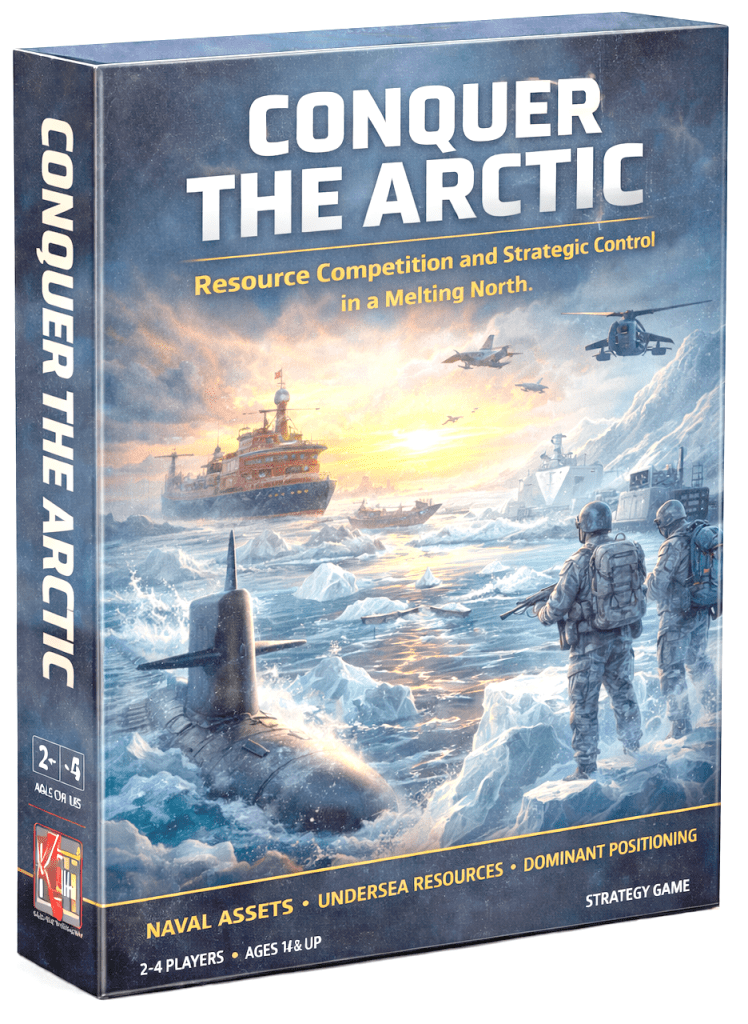
CONQUER THE ARCTIC | As the Ice Melts the Great Power Competition Heats Up
Conquer the Arctic models strategic competition in a region transitioning from inaccessible frontier to contested operating environment. As sea ice retreats, new shipping routes, energy reserves, and undersea infrastructure come into play.
Military forces expand their presence under the cover of civilian missions—search and rescue, scientific research, and environmental monitoring—blurring the line between cooperation and competition. The game reveals how climate change compresses escalation timelines while stretching logistics, creating a theater where miscalculation is easy and recovery is difficult.
Players: 2–4 (Arctic States, Near-Arctic Powers, Commercial Actors)
Simulated Time: 1 minute –30 years
Period Covered: Present day through mid-21st century
Domains: Maritime, Air, Undersea, Space, Energy
Key Technologies: Ice-class vessels, polar ISR, satellite navigation, undersea cables, energy extraction platforms, SSBN, Automated Weather Stations, Living Marine Resources, Fisheries
Gameplay:
Variable ice conditions introducing non-linear uncertainty
Infrastructure placement and protection (ports, airfields, cables)
Lawfare over EEZs, transit rights, and resource claims
Dual-use missions that mask military positioning
Core Tension: Every move can be justified as civilian—until it can’t
System Requirements: OS Windows 11 (64-bit). Processor (CPU):8-core Intel Core i9-14900K or AMD Ryzen 9 7950X3D. Graphics (GPU):NVIDIA GeForce RTX 4080 or RTX 4090. Memory (RAM):32GB DDR5. Storage:1TB or larger NVMe SSD.
Scenarios: Vichy Greenland 2027, Wolverines in Manitoba, Iceland 2028, Svalbard 2028, Novaya Zemlya 2027, Severnaya Zemlya 2030, Acoustical Titanic 2030, Ellesmere 2030, Resolute Bay 2028, Repulse Bay 2035, NANOOK Frost 2028, Polar Campaign Game 2025-2050
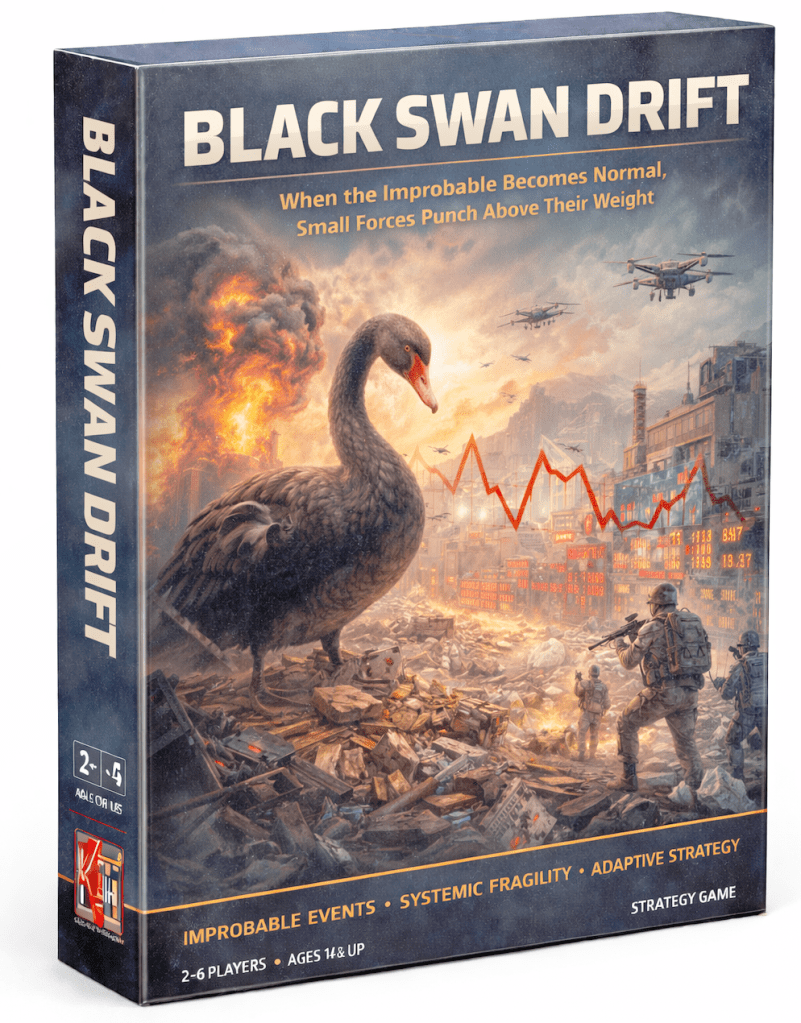
BLACK SWAN DRIFT | Normalizing the Otherwise Highly Improbable with Advanced Technology
In a world where rare events gradually become routine, traditional predictions fail. Black Swan Drift lets players explore how low-probability, high-impact events reshape the battlefield, the market, and geopolitics. Each round models the accumulation of improbable events, forcing players to adapt, exploit, or collapse under stress.
Power, resources, and conventional advantage are only part of the equation; agility, foresight, and opportunism are decisive. Can you anticipate and survive events that the rest of the world treats as impossible? Can your limited resources become decisive through clever positioning, timing, and exploitation of systemic fragility? Or will the drift normalize disasters faster than you can respond?
Players: 2–6
Simulated Time: 1 hour –5 years
Period Covered: Near-future scenarios (2025–2040)
Domains: Political, Military, Economic, Cyber, Social, Technologies
Mechanics:
Probabilistic event decks representing rare shocks
Drift tracker showing gradual normalization of “black swan” events
Power multiplier system for small actors exploiting systemic fragility
Resource and credibility meters that decay or amplify based on exposure to shocks
Gameplay:
Players choose where to invest resilience, where to attack, and when to hedge
Surprises cascade — one improbable event can domino across domains
Small players can punch above their weight if they exploit drift effectively
Key Themes: Improbable Events • Systemic Fragility • Small Actors with Disproportionate Impact • Adaptive Strategy • Risk and Resilience Tradeoffs
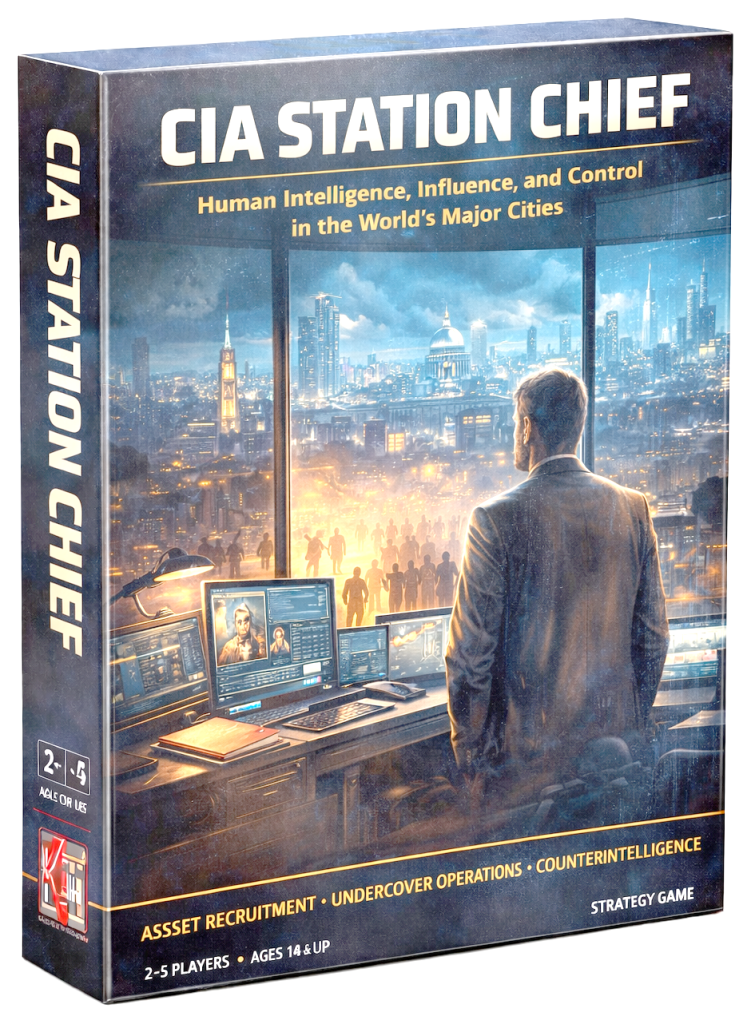
CIA STATION CHIEF | CIA Intelligence, Influence, and Control in the World’s Major Cities
Every major city in the world hosts a CIA safe house and a hidden contest of influence. In CIA Station Chief, players assume the role of senior intelligence officers managing covert stations embedded in global capitals, megacities, and strategic hubs.
Your mission is not battlefield dominance, but access—recruiting assets, shaping local power structures, and protecting the station from exposure. Success depends on judgment, patience, and restraint. Aggressive operations may deliver short-term gains but risk diplomatic crises, compromised assets, or total station collapse.
Players: 2–5 (CIA Career Intelligence Officer + Five Eyes Alliance vs State & Non-state Actors)
Simulated Time: Near real time
Period Covered: Post–Cold War to near future (1995–2035)
Domains: Human, Information, Cyber, Political, Criminal, Military, Covert Special Operations
Technologies: Secure communications, surveillance systems, data analytics, social platforms.
Gameplay & Mechanics
Recruit, manage, and protect human assets across political, military, and criminal networks
Balance intelligence collection, covert action, and liaison relationships with host nations
Navigate counterintelligence pressure, leaks, media exposure, and political oversight
Allocate limited resources across multiple cities and global priorities
Respond to black swan events: coups, protests, scandals, and sudden regime shifts
Player Requirements: Requires Common Access Card (CAC) Multi factor authentication with Top Secret SCI access to JWICS (Joint Worldwide Intelligence Communications System), NSA Net, GWAN NMIS NRO Management, SCION, SIPRNET (Secret Internet Protocol Router Network) NIPRNET (Non Classified Internet Protocol Router Network) and a SCIF.

JADC2 | Joint All Domain Command and Control
JADC2 – Step into the nerve center of modern multi-domain operations. In JADC2, players assume the roles of theater commanders, operators, pilots and gunnery officers managing highly integrated command networks across air, land, sea, space, and cyber domains. Can you maintain global situational awareness and coordinate joint forces under pressure and with contested communications, or will fragmented information and asymmetric surprise threats lead to operational failure?
Real-time decision-making, inter-service coordination, and rapid data analysis are critical as you respond to emerging threats and seize strategic advantage in all domains simultaneously by connecting sensors to shooters in real time.
Players: 1–6 (USA, UK, Canada, NATO vs China, Russia, N Korea, Iran, Non-state Actors)
Ages: Rated M for Mature. Must be 18+
Simulated Time: Modern-day through 2035
Domains: Air, Land, Sea, Cyber, Space, Information, Influence, Kill Chain
Technologies: AI-enabled C2 networks, satellite communications, hypersonic and conventional strike assets, electronic warfare, autonomous vehicles and sensors, secure data links, data center compute infrastructure, edge sensing, mesh networks
Gameplay Features:
Build and defend multi-domain networks under constant attack.
Coordinate joint operations with limited communication bandwidth.
Allocate assets efficiently across global theaters while managing risk.
Use AI algorithms, predictive analytics, and networked sensors to anticipate adversaries.
Simulate realistic delays, fog of war, and cascading operational impacts.
Best for Operators: Networked Operations • Hypersonic Threats • Cyber & Electronic Warfare • Split-Second Decisions • Assumption Testing Sandbox • Connect Sensors to Shooters in Real Time
System Requirements: MOSA Compatible. Also compatible with Lattice via Python, Java, Go, and TypeScript, through gRPC and REST APIs., Compatible with Gotham via a REST API with JSON and OAuth 2.0 for authentication., Compatible with Hivemind Commander & Hivemind Pilot HIL. Also compatible with MAVEN through Maven Smart System MSS User Interface ECS Federal & Scale AI with DAGIR. Not compatible with Windows 10 or Windows XP SP3.
About PWK International
PWK International works at the intersection of technology, geopolitics, and strategy, helping organizations understand how emerging systems shape power, risk, and competition. Drawing on direct experience with U.S. government programs and deep engagement with industry, PWK translates complex, often opaque dynamics into clear frameworks powered by decision grade insights.
The strategy games presented here reflect how PWK approaches real-world problems: modeling complex interactions with realistic models that surface tradeoffs, stress assumptions, and reveal where conventional thinking breaks down. We advise technologists, investors, and policymakers on strategy, transition pathways, and competitive positioning in environments defined by uncertainty and systemic pressure. If these games sharpen how you see the decade ahead, that same lens can be applied directly to your challenges.
PWK International believes that Geopolitics is the new market signal, and strategy games can help not only better predict the future but also shape better outcomes.

















 pwkinternational.com