

In the high-stakes arena of defense contracting, “knowing your customer” isn’t enough—you must know who is legally empowered to award the contract. While your technical team might be winning over the evaluators, the final award is often decided by an individual who has never met you.
This report explores the Department of Defense (DoD) Source Selection Procedures (SSP)—the invisible hierarchy of power that governs how the Pentagon actually awards contracts and spends taxpayer dollars. By understanding the roles of the Source Selection Authority (SSA) and the mechanics of “Best Value,” technologists, suppliers, consultants, and industry leaders can stop pitching features and start pitching to the decision-making logic that controls billions in annual acquisition spend.
This analysis serves as the strategic companion to our Colors of Money report, bridging the gap between appropriation types (the “what”) and the source selection process (the “how”). Where Colors of Money showed how Washington funds innovation, deterrence, and power projection, Are You the Decision Maker? reveals who actually decides who wins and loses.
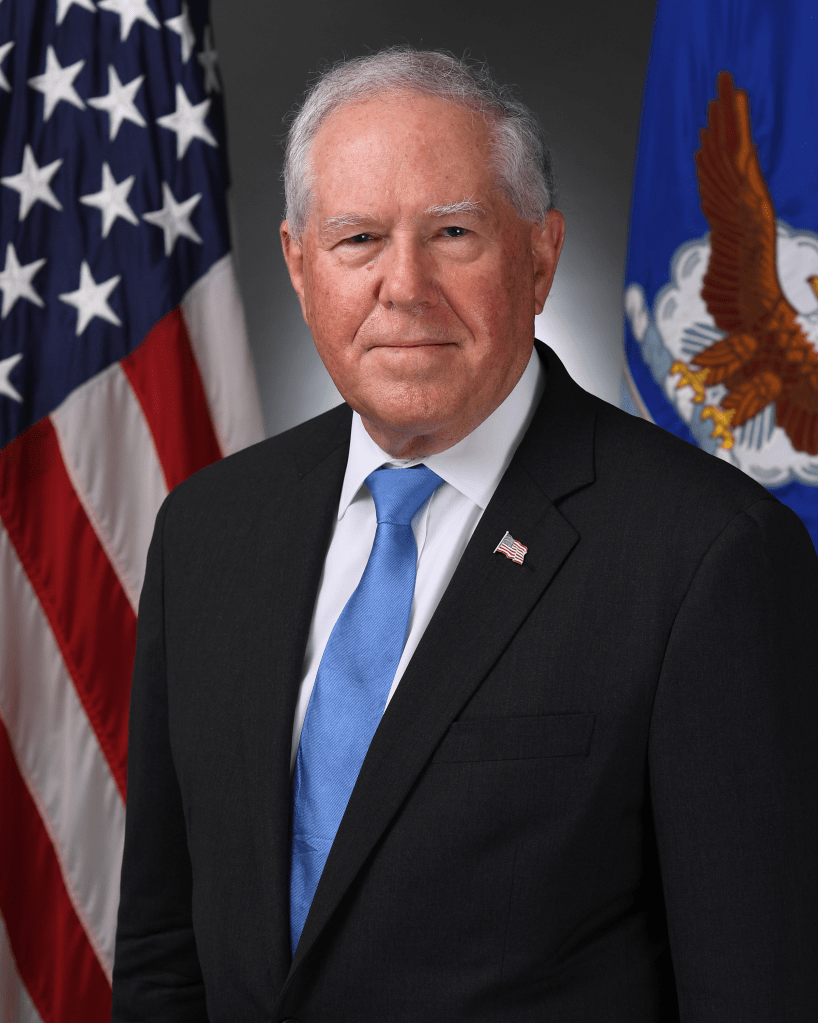
“The likely bias for an acquisition official making the source selection is to take the lowest-price offer; it’s much easier to defend than the subjective judgment that the higher-cost offeror was worth the difference in price.”
Mr. Frank Kendall – former Under Secretary of Defense for Acquisition, Technology, and Logistics (USD AT&L)
The Best Value Continuum: Where Strategy Meets Policy
The SSP often outlines three primary methodologies for awarding contracts: Lowest Price Technically Acceptable (LPTA), Subjective Tradeoff, and Value Adjusted Total Evaluated Price (VATEP).
- The LPTA Trap LPTA is appropriate only when requirements are well-defined and there is “no value, need, or interest to pay for higher performance.” In this scenario, being “better” than the minimum requirement provides zero evaluation benefit. For the supplier, the strategy here is purely operational efficiency and cost leadership.
- The Subjective Tradeoff: The Supplier’s Playground This is used when the government wants to consider a higher-priced offer for better performance but cannot easily place a “quantifiable value” on those enhancements. Here, the Source Selection Decision Document (SSDD) becomes a narrative battle. The SSA must document why your “Significant Strengths” justify a price premium.
- VATEP: The Precision Tool In VATEP, the “value” of better performance is identified and quantified in the RFP. This takes the guesswork out of the tradeoff. If you know the government values a specific technical increment at $5M, you can price your innovation accordingly to remain the “lowest evaluated price” even if your actual bid is higher.
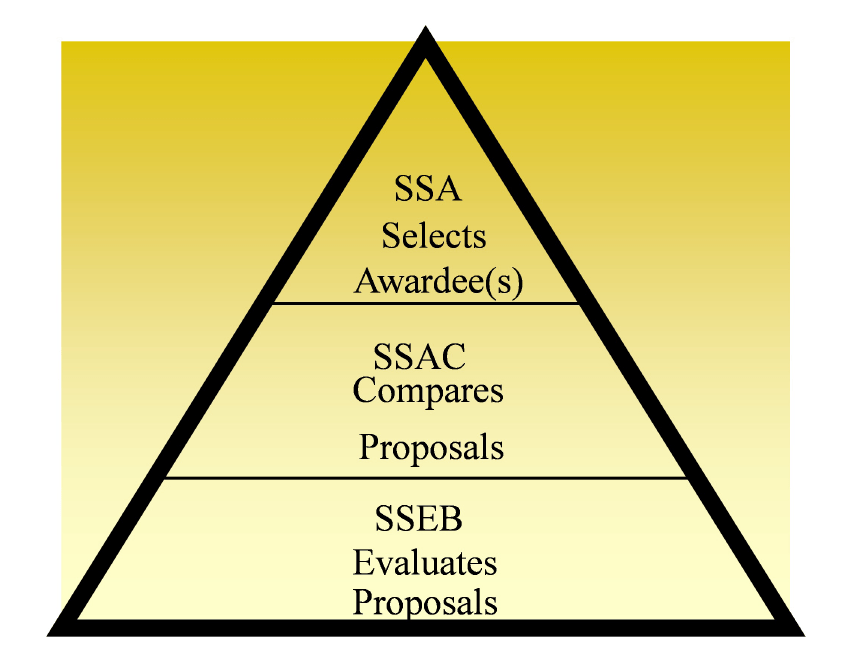
Understanding How Decision Get Made
The Power Dynamics of the Source Selection Team (SST)
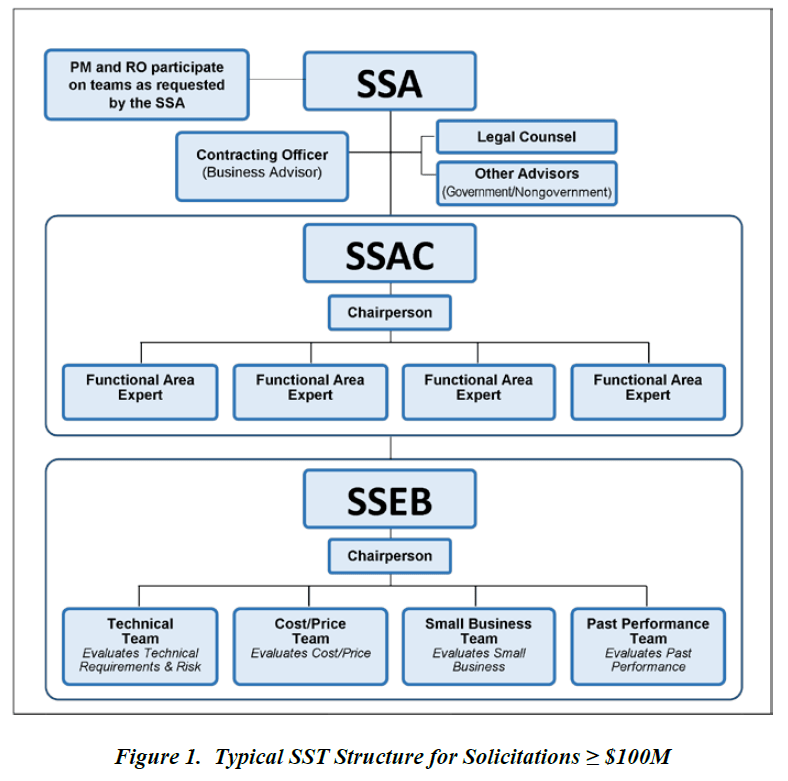
Understanding the “Decision Maker” requires mapping the Source Selection Team (SST):
- The Source Selection Authority (SSA): The ultimate decision-maker. They are responsible for the “proper and efficient conduct” of the process and must personally sign off on the Best Value decision. For any acquisition over $100M, the SSA is a specifically appointed leader—separate from the Contracting Officer.
- The Procuring Contracting Officer (PCO): The primary business advisor and the only person industry is allowed to talk to once the RFP is live.
- The Source Selection Evaluation Board (SSEB): The “engine room.” They conduct the technical and cost evaluations but are prohibited from performing comparative analysis or making recommendations unless specifically asked by the SSA.
- The Source Selection Advisory Council (SSAC): The bridge. They take the SSEB’s raw data and turn it into a “written comparative analysis” for the SSA.
Risk: The Silent Deal-Killer
Policy is crystal clear: “All evaluations that include a technical evaluation factor shall also consider risk.” Risk isn’t just about whether your product works; it’s about the “likelihood of unsuccessful contract performance.”
The DoD uses two primary methodologies for rating risk:
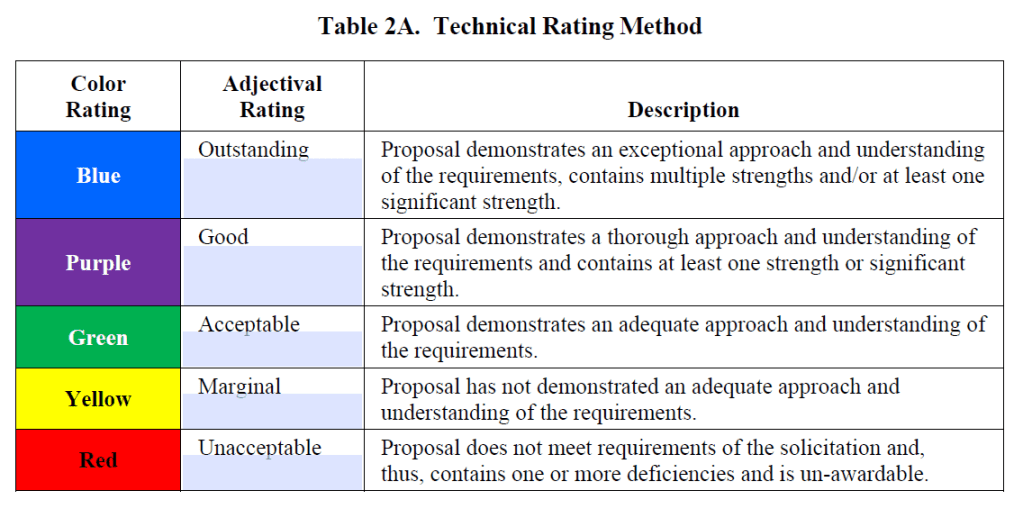
- Separate Ratings – A color for technical merit and an adjectival rating for risk (Low to Unacceptable).
- Combined Ratings – A single color/adjectival rating that bakes risk into the technical assessment (e.g., “Purple/Good” means a thorough approach with low to moderate risk).
For the strategic contractor, the goal is to move the client toward “Normal Government monitoring” (Low Risk) rather than “Close Government monitoring” (Moderate/High Risk).
Debriefings: Turning “No” into Your Next Win
Right after the SSA signs the Source Selection Decision Document, the rules require one final step: debriefings.
Section 3.11 and Appendix A of the DoD Source Selection Procedures (SSP) make this mandatory. The Procuring Contracting Officer must conduct a timely, fact-based debrief for every unsuccessful offeror—pre-award or post-award, per FAR 15.505 or 15.506.
Here’s exactly what you will (and won’t) hear:
- The basis for the award decision
- The strengths and weaknesses of your proposal against the published evaluation criteria
- How your color ratings, risk assessment, and past performance confidence stacked up
- Why your proposal did or did not represent best value
What you will never hear: comparative rankings of other offerors, their prices, or protected source selection information. The SSP is crystal clear on this—debriefs are about your proposal, not theirs.
Smart contractors treat the debrief as a strategic intelligence session, not a complaint forum. Come with targeted questions tied to the SSDD, the SSAC’s comparative analysis, and the exact language in the RFP’s Section M. Use it to map your gaps against the Best Value Continuum, refine your Significant Strengths, and lower your risk profile for the next solicitation.
The SSA’s decision is final, but the next RFP is already in development. A sharp debrief turns today’s loser into tomorrow’s winner.
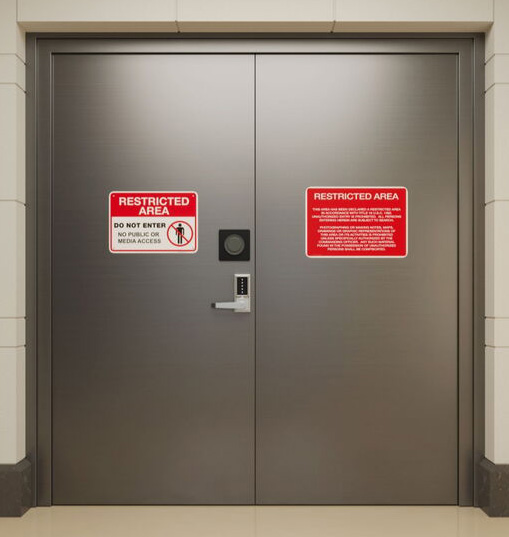

Welcome to a Department of Defense Sensitive Compartmented Information Facility or SCIF — a high-tech vault disguised as an ordinary room where the nation’s most sensitive secrets and offerors proposal volumes are guarded in accordance with Acquisition Policy and Public Law.

Behind its heavy vault door complete with biometric iris scan, cipher lock, and anti-tailgating sensors, the walls are wrapped in copper mesh and acoustic foam that create a perfect Faraday cage, blocking every electromagnetic whisper, radio signal, and laser eavesdropper while deadening sound to a library-level hush.

No windows exist or they’re permanently blacked out, alarmed, and vibration-proof, the network runs completely air-gapped with TEMPEST-certified equipment, intrusion detection systems scream at the slightest anomaly, 24/7 CCTV records every breath, and filtered positive-pressure ventilation keeps even the air classified. Power is redundantly backed up, every visitor is logged with need-to-know precision, and the entire space is swept daily for bugs.
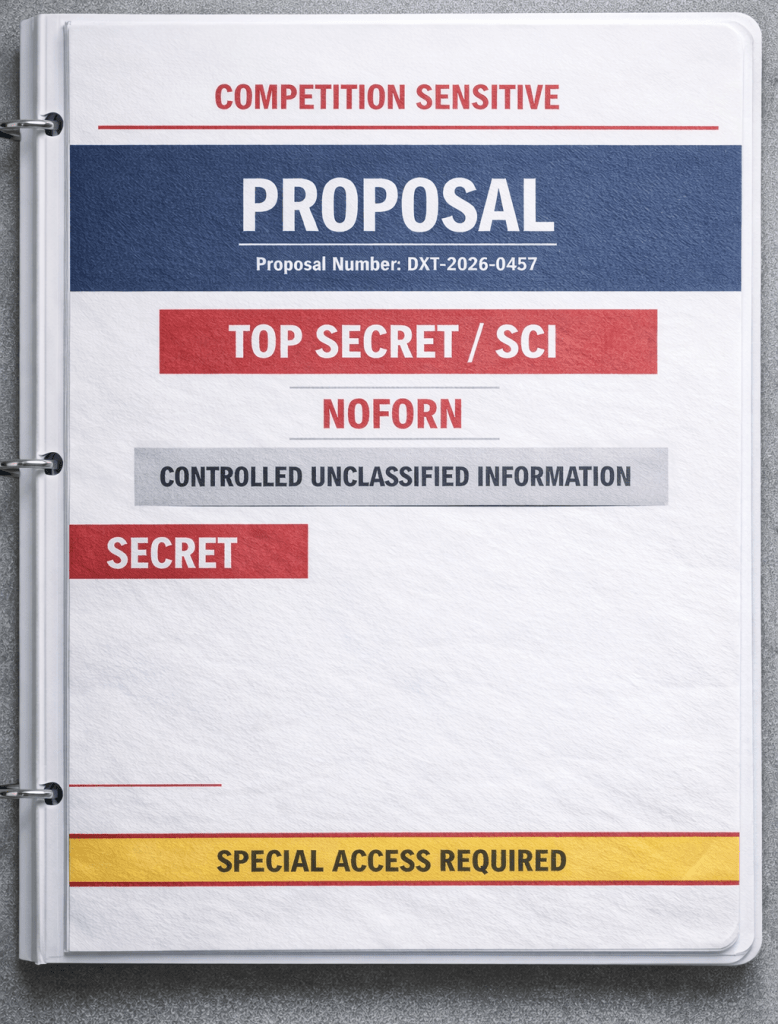
Defense proposals submitted to the U.S. government often include a series of classification and handling markings that indicate how the document must be protected, who may access it, and how it may be distributed during the evaluation and source selection process.

Competition Sensitive – Indicates the proposal contains proprietary or evaluation-sensitive information related to an active government competition and must be protected from unauthorized disclosure.

Controlled Unclassified Information (CUI) – Identifies information that is not classified but still requires safeguarding under federal regulations because it may include sensitive technical, procurement, or operational details.

Distribution Statement (A–F) – A DoD-mandated marking that specifies how technical information may be distributed.

Distribution Statement A – Approved for public release; distribution is unlimited.

Distribution Statement C – Distribution authorized to U.S. Government agencies and their contractors.

Distribution Statement D – Distribution authorized to the Department of Defense and U.S. DoD contractors only.

Secret – A national security classification level applied to information whose unauthorized disclosure could cause serious damage to national security.

Top Secret / SCI (Sensitive Compartmented Information) – The highest level of classification used for intelligence or national security information whose unauthorized disclosure could cause exceptionally grave damage, with SCI indicating access restricted to specific intelligence compartments.

NOFORN (No Foreign Nationals) – A dissemination control marking indicating the information may not be shared with foreign governments, foreign nationals, or international partners.

Special Access Required (SAR / SAP) – Indicates the material is part of a Special Access Program, where access is tightly restricted beyond normal classification levels due to the sensitivity of the technology, program, or mission.
Top Six (6) Takeaways
- The SSA is the “Judge,” Not the “Jury” For any acquisition over $100M, the Source Selection Authority is a specifically appointed leader, separate from the Contracting Officer. They possess the “independent judgment” to make the final call, regardless of lower-level ratings.
- The “Colors of Money” Meet the “Colors of Ratings” Technical excellence is graded on a standardized color scale (Blue, Purple, Green, etc.). A “Blue/Outstanding” rating requires Significant Strengths—aspects of your proposal that exceed requirements to the Government’s “considerable advantage.”
- VATEP: Putting a Price Tag on Innovation The Value Adjusted Total Evaluated Price methodology allows the government to quantify the “value” of better performance in dollars. This allows a higher-priced, technically superior offer to win mathematically.
- The SSAC: The Invisible Influencer On large-scale deals, the Source Selection Advisory Council performs the “comparative analysis” between offerors. They provide the narrative justification the SSA needs to defend a “Best Value” decision.
- Risk is a Rating, Not a Feeling The DoD assesses Technical Risk as a standalone factor (Low, Moderate, High, Unacceptable). Risk evaluates the potential for schedule disruption, cost growth, or performance degradation.
- Past Performance: The “Confidence” Currency The Performance Confidence Assessment measures the Government’s “expectation of success” based on recent and relevant history. “Substantial Confidence” is the highest currency in a tradeoff decision.
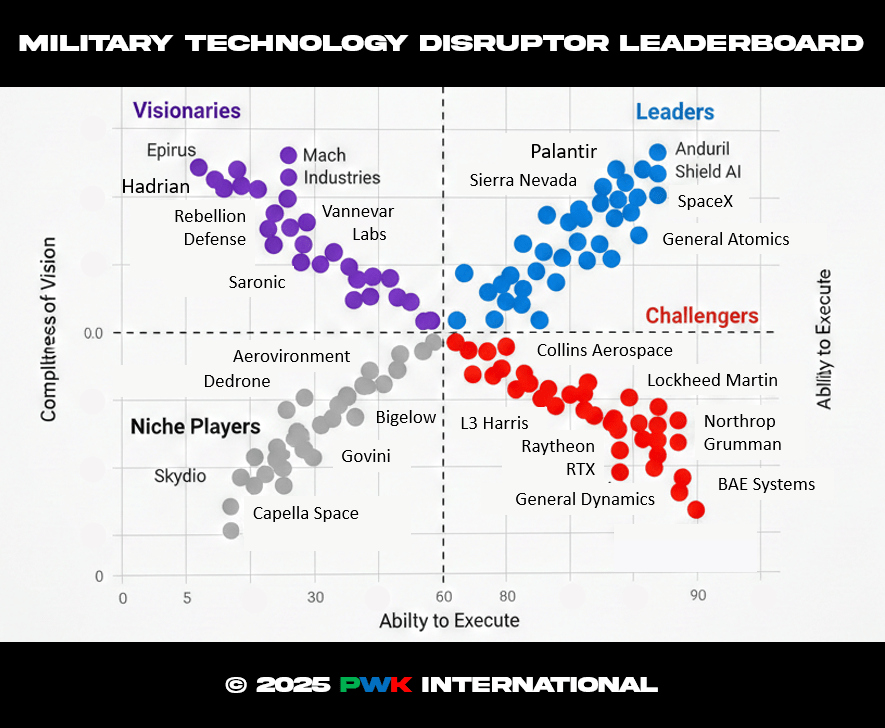
Conclusion: Mastering the Best Value Decision
In the Department of Defense acquisition system, technology alone does not win contracts. The companies that prevail are the ones that understand how decisions are structured—who defines the requirement, who evaluates the proposal, and ultimately who serves as the Source Selection Authority responsible for the final award decision.
Winning a DoD contract is a matter of alignment. The Source Selection Decision Document (SSDD) is the final record of the SSA’s “independent, integrated, comparative analysis.” It must explain why the winner provides the best value consistent with the RFP’s evaluation criteria.
To be the “Decision Maker’s” choice, you must:
- Understand which “Color of Money” is funding the requirement to anticipate the tradeoff methodology.
- Identify and propose “Significant Strengths” that provide a “considerable advantage” to the Government.
- Aggressively mitigate cost, schedule, reputation and technical risk to ensure the SSA feels “Substantial Confidence” in your delivery.
The SSA is the judge, the SSAC is the advisor, and the SSDD is the verdict.
By mastering these procedures, you ensure that when the decision maker sits down to sign, your company and its technical, cost, schedule and risk approach is the only rational choice.
Additional Information:
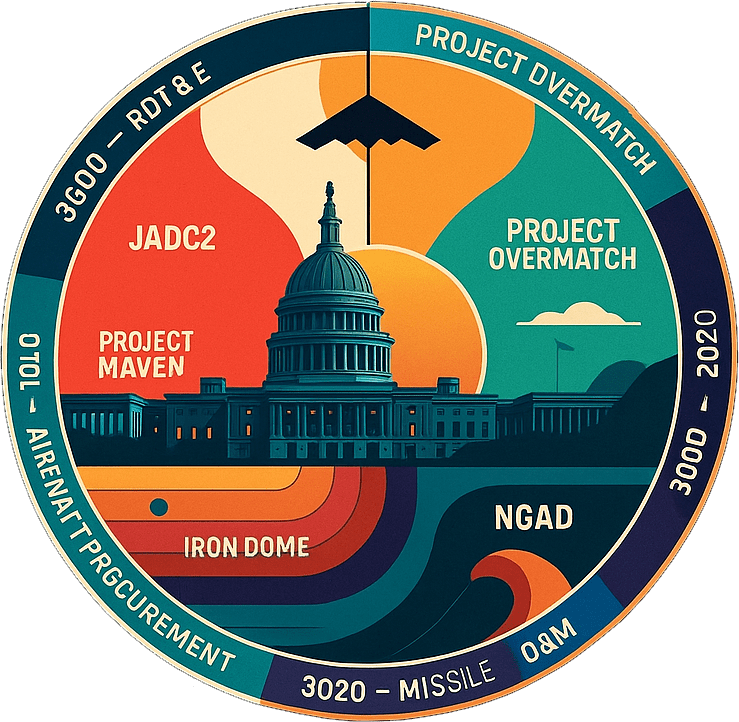
COLORS OF MONEY
How the US Funds Innovation, Deterrence and Freedom of Action
Sources
Department of Defense Source Selection Procedures (August 20, 2022) – The primary official policy document governing all DoD best-value source selections, including SSA authority, ratings tables, VATEP, and debriefings. https://www.acq.osd.mil/dpap/policy/policyvault/USA000740-22-DPC.pdf
FAR 15.101 – Best Value Continuum – The foundational regulation defining the three source selection approaches (tradeoff, LPTA, and hybrids) used throughout the SSP. https://www.acquisition.gov/far/15.101
DFARS Part 215 – Contracting by Negotiation – Implements FAR 15 in DoD with specific PGI links to the 2022 SSP and guidance on SSA appointment for acquisitions over $100M. https://www.acquisition.gov/dfars/part-215-contracting-negotiation
Congressional Research Service – Defense Primer: Lowest Price Technically Acceptable Contracts (updated 2024) – Authoritative overview of LPTA policy, limitations, and its place on the Best Value Continuum. https://crsreports.congress.gov/product/pdf/IF/IF10968
Defense Acquisition University – The Best Value Continuum and Source Selection (2023) – Clear DoD training resource explaining VATEP, Subjective Tradeoff, and how they tie to SSA decision-making. https://www.dau.edu/sites/default/files/2023-09/Best%20Value%20and%20Source%20Selection.pdf
Frank Kendall – “Getting Best Value for the Warfighter and the Taxpayer” (Defense AT&L, 2015; referenced in DAU materials) – The seminal article by the former USD(AT&L) that introduced VATEP and warned against defaulting to lowest price. https://www.dau.edu/library/damag/july-august2019/awarding-best-value-solution
GAO-25-108528 – Defense Acquisition Reform: Persistent Challenges Require New Iterative Approaches (June 2025) – Recent GAO analysis of how rigid source selection contributes to delays and calls for streamlined best-value processes. https://www.gao.gov/products/gao-25-108528
GAO-24-106528 – Defense Contracts: Better Monitoring Could Improve DOD’s Management of Award Lead Times (March 2024) – Highlights how the 2022 SSP streamlining techniques directly impact source selection efficiency and PALT. https://www.gao.gov/assets/gao-24-106528.pdf
DAU Acqipedia – Source Selection – Concise official glossary and explanation of SSA, SSAC, SSEB roles, and documentation requirements. https://www.dau.edu/acquipedia-article/source-selection
Army Federal Acquisition Regulation Supplement (AFARS) Appendix AA – Army Source Selection Supplement (2025) – Service-level implementation of the DoD SSP with practical examples of debriefings and risk evaluation. https://www.acquisition.gov/afars/appendix-aa-table-contents
DAU – Better Buying Power & VATEP Guidance – Direct tie-in between funding “Colors of Money” and source selection methodologies. https://www.dau.edu/sites/default/files/Migrate/DATLFiles/Jul-Aug2014/Kendall.pdf
DoD Source Selection Debriefing Guide (Appendix A of SSP) – Official template and rules for post-award debriefings referenced throughout the procedures. (Contained in the main SSP PDF above; specific section discussion at https://www.acq.osd.mil/dpap/policy/policyvault/USA000740-22-DPC.pdf)
NDIA Vital Signs 2025 Report – Industry perspective on how SSP changes affect defense contractors and the need for better understanding of SSA decision logic. https://www.ndia.org/-/media/sites/ndia/policy/vital-signs/2025/vitalsign_2025_final.pdf
About PWK International
PWK International serves the technologists, suppliers, consultants, and industry leaders who deliver decisive deterrence and freedom of action for the DoD and Federal agencies. Whether you are a Silicon Valley disruptor entering the defense market for the first time or an established prime chasing a multi-billion-dollar program, we equip you with the insider knowledge and tactical edge required to outmaneuver the competition. Our clients win because they understand the system at the same level the decision makers do.
Following our flagship Colors of Money report—which broke down how Washington funds innovation—our new report, Are You the Decision Maker?, pulls back the curtain on how the Source Selection Authority actually chooses winners.
Because when it comes to the Department of War’s multi-billion research, acquisition and sustainment lines of effort, knowing how and who decides is the ultimate competitive advantage.


















 pwkinternational.com